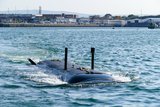
Lockheed laid keel for LCS 15


Lockheed Martin has laid the keel for the US Navy’s fifteenth Littoral Combat Ship (LCS) at Fincantieri Marinette Marine in Marinette, Wisconsin, the company announced on 2 November.
The LCS 15 is the future USS Billings. Like the rest of the fleet, the vessel will be outfitted with interchangeable mission modules to conduct various missions, including anti-surface warfare, anti-submarine warfare, and mine countermeasures.
The industry team building Billings has delivered three ships and has seven other ships in various stages of construction and testing. The future USS Milwaukee (LCS 5) is due to be commissioned in Milwaukee on 21 November.
Joe North, vice president of littoral ships and systems, Lockheed Martin, said: ‘The LCS platform is proving the navy’s concept of operations with its flexibility in supporting a broad range of missions, from anti-submarine and anti-surface warfare to mine countermeasures. This industry has shown it can adapt to meet the navy’s most challenging missions, anywhere in the world.’



More from Naval Warfare
-
![From the Baltic to the Gulf: where USV procurement is heading next]()
From the Baltic to the Gulf: where USV procurement is heading next
Saildrone’s new Copenhagen base is one sign of a larger shift, as navies globally turn to uncrewed vessels for surveillance and mine clearance.
-
![Quantum sensing gathers pace as navies eye undersea advantage]()
Quantum sensing gathers pace as navies eye undersea advantage
As AI dominates defence conversations, industry increasingly points to quantum sensing as the technology set to change submarine and uncrewed underwater vehicle operations.
-
![Competitive P17B tender marks a shift in Indian Navy frigate procurement]()
Competitive P17B tender marks a shift in Indian Navy frigate procurement
The Indian Navy's P17B programme is expected to combine greater weapons capacity with a competitive domestic construction model, although key systems could remain dependent on international supply chains.
-
![How France’s SNLE 3G programme is reshaping the naval nuclear industrial base]()
How France’s SNLE 3G programme is reshaping the naval nuclear industrial base
Extending far beyond a four-submarine replacement programme, France’s ballistic missile submarine effort is a decades-long industrial initiative designed to preserve the country’s ability to build and sustain nuclear-powered strategic platforms.