Leonardo to lead OCEAN2020 project


Leonardo has been awarded the tender for the European Defence Fund’s OCEAN2020 initiative, the company announced on 12 January.
The project aims to use unmanned technology to boost Europe’s maritime defence capabilities. Different types of unmanned platforms - fixed wing, rotary wing, surface and underwater - will be integrated with naval units’ command and control (C2) centres to enhance naval surveillance and interdiction capabilities.
In addition to simulation work, unmanned systems from a number of providers will take place in maritime demonstrations where data will be exchanged with land-based C2 centres and Italian naval vessels via satellite communication links.
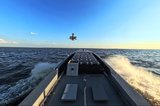
The first demonstration, scheduled to take place in the Mediterranean Sea in 2019, will be coordinated by the Italian Navy and will see Leonardo’s Hero and Solo unmanned helicopters operate from Italian naval units alongside other European partners.
The second demonstration, scheduled to take place in 2020 in the Baltic Sea, will be coordinated by the Swedish Navy. The data collected by various systems during these demonstrations will be processed and sent to a prototype European C2 centre in Brussels.
Alessandro Profumo, CEO of Leonardo, said: ‘It is the leading technological research project dedicated to the very topical issue of maritime surveillance, which is of interest across Europe and to the Mediterranean region in particular. This success has been made possible thanks to the strong collaboration between all 42 team partners which we have the honour to lead.’
The OCEAN2020 team, led by Leonardo, comprises 42 partners from 15 European countries. These include the ministries of defence of Italy, Greece, Spain, Portugal and Lithuania, with additional support from Sweden, France, the UK, Estonia and the Netherlands. European industrial partners include Indra, Safran, Saab, MBDA, PGZ/CTM, Hensoldt, Intracom-IDE, Fincantieri and QinetiQ.
Related Equipment in Defence Insight

More from Naval Warfare
-
![Australian industry programme builds pipeline for Virginia-class sustainment]()
Australian industry programme builds pipeline for Virginia-class sustainment
Australian businesses can now bid to support Virginia-class submarine sustainment in Western Australia, as momentum around the Henderson Defence Precinct also builds.
-
![South Korea, Japan and Turkey vie for US shipbuilding access in future frigate contest]()
South Korea, Japan and Turkey vie for US shipbuilding access in future frigate contest
Washington’s search for a foreign-built frigate could hand South Korea, Japan and Turkey a larger prize than a double-hull order: a foothold inside the US shipbuilding industrial base.
-
![German Navy’s Israeli missile test points to deepening defence-industrial ties]()
German Navy’s Israeli missile test points to deepening defence-industrial ties
The test-firing of an Israel Aerospace Industries LORA ballistic missile from a German vessel highlights the Bundeswehr’s focus on speed to capability as it trials Israel’s operationally proven technology.