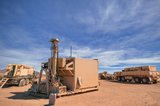
Babcock nears first customer for Nomad AI translation tool
Nomad can provide militaries with real-time intelligence, saving critical time on the battlefield.
The US Army has begun rolling out its new night vision equipment it announced on 1 November.
The 2nd Armored Brigade Combat Team (ABCT), 1st Infantry Division, has become the first unit to receive the Enhanced Night Vision Goggle - Binocular (ENVG-B) and the Family of Weapon Sights - Individual (FWS-I). The ABCT began fielding the equient in September.
The ENVG-B and FWS-I systems are the most advanced night vision equipment in the US Army. The ENVG-B and FWS-I allow soldiers to see through fog, dust, and smoke, in both day and night environments.
'The ENVG-B will truly be the greatest goggle that we've ever fielded,' said Brig Gen Anthony Potts, PEO Soldier. 'The thermal channel has a day-night capability and we've added in things like augmented reality.'
Initially 2nd ABCT soldiers spent two-days in a classroom learning the basics of the equipment, followed by hands-on training at firing ranges. Further training on the new equipment will be conducted over the next several months.
The ENVG-B and FWS-I were designed with the input of soldiers in a collaborative effort with PEO-Soldier and SL-CFT using soldier feedback early on in the development to inform design.
Nomad can provide militaries with real-time intelligence, saving critical time on the battlefield.
Taurus operates alongside the Israel Defense Forces’ Orion system which supports mission management across tens of thousands of manoeuvring forces, from squad leaders to battalion commanders.
The plan for the new displays follows fresh investment in Kopin’s European facilities by Theon and an order for head-up displays in fielded aircraft, with funding from the US Department of Defense.
Persistent Systems received its largest ever single order for its MPU5 devices and other systems earlier this month and has already delivered the 50 units to the US Army’s 4th Infantry Division.
Turkey has joined the family of countries attempting to establish a multilayered air defence system with government approval in August 2024 for the effort landed by Aselsan. Dubbed Steel Dome, the programme joins Israel’s Iron Dome, the US Golden Dome, India’s Mission Sudarshan Chakra and South Korea’s low-altitude missile defence system.
MARSS’ NiDAR system has been deployed using sensors from static platforms to provide detection and protection for static sights, such as critical infrastructure, ports and military bases.