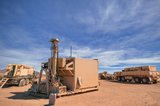
Boeing’s anti-jamming technology completes testing
Boeing’s anti-jamming communications technology has proven its ability to operate as a ground-based user terminal and satellite-based networking hub, providing a potential alternative to existing terminals and satellites for military users.
The anti-jam technology uses a protected tactical waveform, which shields signals from interference by adversaries or cyber-terrorists.
The recent testing, done under contract for the US Air Force Space and Missile Systems Center and supervised by the US government, was conducted between a Boeing ground terminal using a programmable modem, designed and developed by ViaSat using one of its commercial off-the-shelf platforms and a ground terminal designed and built by MIT-Lincoln Laboratory.
It confirmed that the modem meets technical interface specifications, while successfully transmitting information to and from the ground user terminal.
Previous on-orbit demonstrations over satellites like ViaSat-1 and the sixth Wideband Global SATCOM (WGS-6) have also shown the technology’s ability to operate anti-jam waveforms over existing commercial and military spacecraft.
Dan Hart, vice president, Boeing Government Satellite Systems, said: ‘We’ve confirmed this technology can be applied quickly and affordably to existing assets, especially operational WGS satellites and ground terminals. With threats to secure communications becoming increasingly frequent and sophisticated, providing this enhanced capability to warfighters on the ground is critical.’



More from Digital Battlespace
-
![Artificial intelligence: the hope, the hype and the real-world reality]()
Artificial intelligence: the hope, the hype and the real-world reality
Artificial intelligence has supported C2 systems and decision-making for more than two decades. It has gradually built up a head of steam in the 2020s, but what is it achieving today and what role could it play in the future?
-
![SOF Week 2026: How SOF Teams Are Powering Radios, Drones and Battlefield Networks (video)]()
SOF Week 2026: How SOF Teams Are Powering Radios, Drones and Battlefield Networks (video)
At SOF Week 2026, Sean O’Neill, Senior Business Development Manager with Iris Technology, discusses the growing importance of tactical power management systems for modern military operations.
-
![SOF Week 2026: How SOF Operators Are Driving the Future of Battlefield Communications (video)]()
SOF Week 2026: How SOF Operators Are Driving the Future of Battlefield Communications (video)
At SOF Week 2026, Austin Farnham, President of Octane Wireless, discusses how direct feedback from special operations forces is helping shape the next generation of battlefield communications technology.
-
![World Defense Show 2026: Northrop Grumman to present improved C2 management system]()
World Defense Show 2026: Northrop Grumman to present improved C2 management system
The Northrop Grumman Integrated Battle Command System is in service with Poland and the US Army with another 20 countries believed to have expressed an interest.
-
![Thales looks to boost DigitalCrew system through AI and human-machine teaming trials]()
Thales looks to boost DigitalCrew system through AI and human-machine teaming trials
The Thales DigitalCrew package, first unveiled at last year’s Defence IQ International Armoured Vehicles conference, is designed to merge imaging and apply a layer of decision-making and observation algorithms to support crew and other personnel.
-
![Babcock nears first customer for Nomad AI translation tool]()
Babcock nears first customer for Nomad AI translation tool
Nomad can provide militaries with real-time intelligence, saving critical time on the battlefield.