Taiwan stresses Central America ties with navy visit


A Taiwanese navy flotilla docked in Nicaragua on 9 April in a high-profile visit highlighting ties with Central America and the Caribbean that are shrinking as China presses countries in the region to drop diplomatic relations.
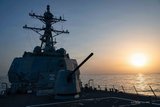
The three vessels – described as being on a training mission – powered into Corinto, a port town on Nicaragua’s Pacific coast, in a visit ‘to strengthen the ties of friendship,’ Nicaraguan officials and Taiwanese diplomats said.
Some of the 800 crew members who disembarked put on a Taekwondo martial arts display after an inspection by Nicaraguan military brass.
The warships were Pan Shi, a fast combat support ship, Pan Chao, an older, US-designed frigate, and Kuen Wing, a more recent, French-made stealth frigate.
They were to stay in port for three days, with the crew of officers, sailors and cadets participating with the Nicaraguan military in joint training activities, the Taiwanese embassy said.
It was the sixth time Taiwan has sent a ‘friendship flotilla’ to Nicaragua.
After Nicaragua, Taiwan’s navy ships were to go on to make stops in the Marshall Islands, El Salvador, Honduras, Guatemala and the Dominican Republic.
Taiwan is gradually running out of ports of call as China – which considers Taiwan a renegade province that will one day be brought back under Beijing’s control – presses countries to drop relations with Taipei.
Half the countries with which Taiwan has bilateral diplomatic relations are in Latin America and the Caribbean. And it is slowly losing ground there.
In June 2017, Panama cut ties with Taiwan to open relations with China instead. Costa Rica did likewise in 2007.
The parts of Latin America that still have ties with Taiwan are the Central American countries of Belize, El Salvador, Guatemala, Honduras and Nicaragua; the Caribbean states of Haiti, St Kitts and Nevis, St Vincent and the Grenadines, the Dominican Republic, and Santa Lucia; and the South American nation of Paraguay.
Across the region, China’s increased investment and a more assertive foreign policy are being felt both economically and politically.
That trend has unsettled the US, which views the Chinese interest as encroachment in a region that it once regarded as its backyard.
US President Donald Trump is to attend a summit of leaders across the Americas in Peru on 13 and 14 April.
White House officials said part of his focus would be on pushing back against ‘external economic aggression,’ taken to mean China’s growing investment in the region.


More from Defence Notes
-
![US Pentagon pushes for major reform of defence acquisition system]()
US Pentagon pushes for major reform of defence acquisition system
The US Department of Defense has requested new contracting authorities from Congress, using the Army's MV-75 Cheyenne programme to demonstrate how competition, digital engineering and closer industry collaboration could accelerate acquisitions.
-
![US speeds up B61-13 nuclear bomb production as programme moves further ahead of schedule]()
US speeds up B61-13 nuclear bomb production as programme moves further ahead of schedule
The US government plans to accelerate production even further after achieving key B61-13 milestones months ahead of schedule, as the programme advances amid growing US-China strategic competition.
-
![Canada’s C$2 billion ACSV deal reinforces new defence industrial strategy as allies align]()
Canada’s C$2 billion ACSV deal reinforces new defence industrial strategy as allies align
General Dynamics Land Systems-Canada is the country’s first strategic partner under the Defence Industrial Strategy’s Strategic Partnership Framework, an effort to provide companies with confidence to invest and boost the defence labour force.
-
![New UK armed forces minister frames High North defence as vital to “homeland security”]()
New UK armed forces minister frames High North defence as vital to “homeland security”
The UK’s Minister for the Armed Forces Louise Sandher-Jones made her first appearance in the role before the House of Commons Defence Committee this week to highlight efforts to improve capability in the High North.
-
![Canada seeks to strengthen industrial ties with the US on classified programmes]()
Canada seeks to strengthen industrial ties with the US on classified programmes
Ottawa explores expanding defence-industrial cooperation with Washington into sensitive programmes, an approach that could reshape NORAD modernisation, strengthen North American supply chains and create new opportunities for defence contractors.