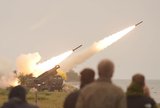
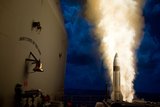
Saudi air defences intercept two missiles over Riyadh


Saudi Arabia's air defences intercepted two ballistic missiles over the capital Riyadh on Wednesday, state television Al-Ekhbariya said.
Two explosions were heard in the city, according to an AFP photographer.
A spokesman for the Saudi-led coalition said Saudi air defences hours earlier had also intercepted a ballistic missile originating from Yemen and targeting Saudi Arabia's southern city of Jizan.
Colonel Turki al-Maliki blamed the "Iran-backed Huthi" rebels in Yemen for the attack. Riyadh has long accused its regional rival Tehran of supplying the Huthis with ballistic missiles.
Saudi Arabia launched a military coalition in Yemen in 2015, aimed at rolling back the Huthis and restoring the internationally recognised government to power.
The Huthis have in recent months intensified missile attacks against Saudi Arabia.
The latest salvo came a day after US President Donald Trump exited the Iran nuclear agreement, which he criticised for not including measures to curb Tehran's ballistic missile programme.



More from Defence Notes
-
![Estonia opts for smart, adaptable and cooperative solutions in the face of Russian threat]()
Estonia opts for smart, adaptable and cooperative solutions in the face of Russian threat
Estonian-made equipment is being put through the toughest of evaluations in the hands of Ukrainian soldiers resisting the full-scale Russian invasion which began in 2022. The country has long seen the threat and is continuing to adapt for the future.
-
![UK faces cost of balancing defensive capabilities abroad as Iran conflict widens]()
UK faces cost of balancing defensive capabilities abroad as Iran conflict widens
The UK has recently deployed a Type 45 destroyer to Cyprus and has bolstered its presence in the Middle East in recent weeks with supporting air power to protect neighbouring countries’ air defences.
-
![White House calls on Pentagon contractors to “rapidly and aggressively” boost weapon production]()
White House calls on Pentagon contractors to “rapidly and aggressively” boost weapon production
Intended to sustain Operation Epic Fury against Iran, efforts to increase the production of weapons and ammunition could expose long-standing weaknesses in the US defence industrial base.
-
![India’s strategic defence footprint expansion could be accelerated by Iran-Israel conflict]()
India’s strategic defence footprint expansion could be accelerated by Iran-Israel conflict
The latest escalation between Iran and Israel could shape New Delhi’s next-generation shield as India deepens cooperation with Israel on missile defence and drone production.
-
![Is the US magazine of air defence interceptors deep enough to sustain a long campaign against Iran?]()
Is the US magazine of air defence interceptors deep enough to sustain a long campaign against Iran?
The Pentagon spent a considerable number of THAAD and SM-3 rounds to defend against Iranian missiles in 2025 and has not fully replenished its reserves.