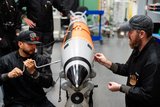
Experts expect ‘crawl, walk, run,’ process to make Skyborg a success
In light of debate surrounding how well-suited loyal wingman aircraft are in competing against IADS and hypersonic missiles, analysts are confident the systems will eventually prove themselves in contested environments.


Despite low cost, attritable UAV projects still yet to prove themselves in operational settings and questions remaining about their utility against high-end threats or overcoming deployment challenges, defence analysts are highly confident current developments will lead to a new era of loyal wingmen adding considerable capability to fighter jet fleets.
The USAF has already partnered with a host of industry partners on the Skyborg autonomous UAV programme that seeks a fighter-like platform equipped to iteratively field AI systems and set to take on future operations in A2/AD environments.
‘The concept will work, unquestionably,’ Mark Gunzinger, director of future concepts and
Our news & analysis is now part of Defence Insight®
A Basic-level or higher Defence Insight subscription is now required to view this content.




More from Defence Notes
-
![From systems integrator to multi-domain solutions provider (video)]()
From systems integrator to multi-domain solutions provider (video)
Philipp von Brandenstein, Head of Corporate Communications at Rheinmetall, explains how Eurosatory 2026 marked a new stage in the company's evolution.
-
![US speeds up B61-13 nuclear bomb production as programme moves further ahead of schedule]()
US speeds up B61-13 nuclear bomb production as programme moves further ahead of schedule
The US government plans to accelerate production even further after achieving key B61-13 milestones months ahead of schedule, as the programme advances amid growing US-China strategic competition.
-
![Canada’s C$2 billion ACSV deal reinforces new defence industrial strategy as allies align]()
Canada’s C$2 billion ACSV deal reinforces new defence industrial strategy as allies align
General Dynamics Land Systems-Canada is the country’s first strategic partner under the Defence Industrial Strategy’s Strategic Partnership Framework, an effort to provide companies with confidence to invest and boost the defence labour force.
-
![New UK armed forces minister frames High North defence as vital to “homeland security”]()
New UK armed forces minister frames High North defence as vital to “homeland security”
The UK’s Minister for the Armed Forces Louise Sandher-Jones made her first appearance in the role before the House of Commons Defence Committee this week to highlight efforts to improve capability in the High North.
-
![Canada seeks to strengthen industrial ties with the US on classified programmes]()
Canada seeks to strengthen industrial ties with the US on classified programmes
Ottawa explores expanding defence-industrial cooperation with Washington into sensitive programmes, an approach that could reshape NORAD modernisation, strengthen North American supply chains and create new opportunities for defence contractors.