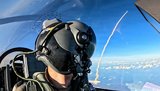
Lockheed Martin to upgrade Sniper Advanced Targeting Pod’s digital data link capability
The US Air Force awarded Lockheed Martin a $13 million contract to upgrade the Sniper Advanced Targeting Pod’s (ATP) existing data link with an enhanced digital Compact Multi-band Data Link (CMDL). This upgrade expands the Sniper pod’s current video data link capabilities by enabling digital transmission of high definition imagery and metadata between aircrews and ground troops at extended ranges.
“Video datalink capability is in every Sniper pod supporting US military operations and has proven to greatly aid in non-traditional intelligence, surveillance and reconnaissance for ground forces,” said Bill Spangenberg, Sniper ATP program manager at Lockheed Martin Missiles and Fire Control. “Sniper has reduced engagement timelines for close air support ten-fold, which is critical to saving lives.”
The CMDL upgrade increases long-range battlefield situational awareness and positive target coordination and confirmation, while protecting air-to-ground transmissions from enemy exploitation. CMDL communicates seamlessly with the fielded ROVER family of ground stations including ROVER 5, a portable handheld transceiver.
The CMDL upgrade follows the S3.5 software upgrade of US Air Force and coalition Sniper pods operational on F-16 Block 30/40/50, A-10C, F-15E and B-1 aircraft. The S3.5 adds emerging aircraft interfaces to Sniper ATP and provides new capabilities in air-to-air and air-to-surface tracking and designation, selectable ground-stabilized fragmentation circles, unpowered built-in-test data download capability, and video data link metadata and symbology enhancements. The Sniper pod’s modular architecture enables field-level retrofit and facilitates 98 percent fleet availability.
Also operational on the CF-18, Harrier GR7 and GR9 aircraft, Sniper ATP platform expansion continues on the B-52, Tornado and Typhoon with further expansion envisioned to unmanned aerial vehicles and additional aircraft.
Source: Lockheed Martin





More from Defence Notes
-
![From systems integrator to multi-domain solutions provider (video)]()
From systems integrator to multi-domain solutions provider (video)
Philipp von Brandenstein, Head of Corporate Communications at Rheinmetall, explains how Eurosatory 2026 marked a new stage in the company's evolution.
-
![Canada’s C$2 billion ACSV deal reinforces new defence industrial strategy as allies align]()
Canada’s C$2 billion ACSV deal reinforces new defence industrial strategy as allies align
General Dynamics Land Systems-Canada is the country’s first strategic partner under the Defence Industrial Strategy’s Strategic Partnership Framework, an effort to provide companies with confidence to invest and boost the defence labour force.
-
![New UK armed forces minister frames High North defence as vital to “homeland security”]()
New UK armed forces minister frames High North defence as vital to “homeland security”
The UK’s Minister for the Armed Forces Louise Sandher-Jones made her first appearance in the role before the House of Commons Defence Committee this week to highlight efforts to improve capability in the High North.
-
![Canada seeks to strengthen industrial ties with the US on classified programmes]()
Canada seeks to strengthen industrial ties with the US on classified programmes
Ottawa explores expanding defence-industrial cooperation with Washington into sensitive programmes, an approach that could reshape NORAD modernisation, strengthen North American supply chains and create new opportunities for defence contractors.