Canada to accept bid from Boeing for new fighter jets


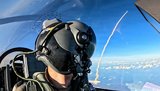
Canada said on 22 February that it was allowing Boeing to submit a bid to replace the country’s aging F-18 fleet, after an earlier trade dispute between the American manufacturer and Ottawa.
The announcement came a month after the US International Trade Commission rejected a complaint filed by Boeing against its Canadian rival Bombardier, demanding nearly 300 percent anti-dumping duties on the C Series passenger plane.
Boeing, which makes the Super Hornet, is one of five manufacturers invited to submit proposals in spring 2019 for an order of 88 advanced fighter jets, which are to be delivered in 2025, according to a Canadian government statement.
The other manufacturers are US-based Lockheed Martin (F35), France’s Dassault (Rafale), the Airbus group (Eurofighter Typhoon), and Sweden’s Saab (Gripen).
Ottawa will evaluate the bids based on ‘cost, technical requirements and economic benefits,’ the government said. The winning bidder will have to invest in Canada an amount equal to the value of the contract.
Carla Qualtrough, Canadian Minister of Public Services and Procurement, said: ‘Our government is confident this will result in a robust competition, providing good value to Canadians and the Canadian economy.’
In December, the Canadian government scrapped a deal to buy 18 Boeing Super Hornets at a cost of more than $5 billion, following Boeing’s complaint against Bombardier.
Boeing had accused the Canadian company of selling the C Series, which can seat between 100 and 150 passengers, at a loss to Delta Air Lines.

You may also like
More from Defence Notes
-
![From systems integrator to multi-domain solutions provider (video)]()
From systems integrator to multi-domain solutions provider (video)
Philipp von Brandenstein, Head of Corporate Communications at Rheinmetall, explains how Eurosatory 2026 marked a new stage in the company's evolution.
-
![US Pentagon pushes for major reform of defence acquisition system]()
US Pentagon pushes for major reform of defence acquisition system
The US Department of Defense has requested new contracting authorities from Congress, using the Army's MV-75 Cheyenne programme to demonstrate how competition, digital engineering and closer industry collaboration could accelerate acquisitions.
-
![US speeds up B61-13 nuclear bomb production as programme moves further ahead of schedule]()
US speeds up B61-13 nuclear bomb production as programme moves further ahead of schedule
The US government plans to accelerate production even further after achieving key B61-13 milestones months ahead of schedule, as the programme advances amid growing US-China strategic competition.
-
![Canada’s C$2 billion ACSV deal reinforces new defence industrial strategy as allies align]()
Canada’s C$2 billion ACSV deal reinforces new defence industrial strategy as allies align
General Dynamics Land Systems-Canada is the country’s first strategic partner under the Defence Industrial Strategy’s Strategic Partnership Framework, an effort to provide companies with confidence to invest and boost the defence labour force.
-
![New UK armed forces minister frames High North defence as vital to “homeland security”]()
New UK armed forces minister frames High North defence as vital to “homeland security”
The UK’s Minister for the Armed Forces Louise Sandher-Jones made her first appearance in the role before the House of Commons Defence Committee this week to highlight efforts to improve capability in the High North.
-
![Canada seeks to strengthen industrial ties with the US on classified programmes]()
Canada seeks to strengthen industrial ties with the US on classified programmes
Ottawa explores expanding defence-industrial cooperation with Washington into sensitive programmes, an approach that could reshape NORAD modernisation, strengthen North American supply chains and create new opportunities for defence contractors.