Threatened India issues flurry of UAV orders
The SkyStriker is a fully autonomous loitering munition that carries either a 5kg or 10kg warhead. (Elbit Systems)
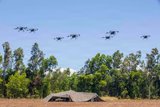
Swarm UAVs, loitering munitions and counter-UAS systems are now all on Indian order books.


In an unprecedented move, India’s MoD has signed multiple niche contracts cumulatively worth around $180 million for UAVs. These are mostly with the private sector under emergency procurement contracts.
The volatile situation on India’s borders, with increasing UAV attacks and hostile neighbours, to which Afghanistan is a recent addition, has necessitated the move.
The Indian Army that bestowed the lion’s share of orders will get around 100 SkyStriker loitering munitions to be supplied in a year by a JV between Bengaluru-based Alpha Design and Elbit Systems. The SkyStriker was used during the war between Armenia and Azerbaijan.
Start-up NewSpace Research
Our news & analysis is now part of Defence Insight®
A Basic-level or higher Defence Insight subscription is now required to view this content.




More from Air Warfare
-
![USAF eyes sensor and weapon upgrades as MH-139A Grey Wolf achieves IOC]()
USAF eyes sensor and weapon upgrades as MH-139A Grey Wolf achieves IOC
The Grey Wolf has entered operational service nearly three years later than originally planned, while new sustainment contracts indicate that some UH-1Ns could remain supported until 2031.
-
![How geopolitics and new military alliances are disrupting combat aircraft procurement]()
How geopolitics and new military alliances are disrupting combat aircraft procurement
Selection of fighter aircraft by national governments has always been political. As markets and allegiances shift against a background of global realignment, who will be the winners and losers as new entrants compete with established suppliers?
-
![Singapore’s interest in GCAP reflects its long-term approach to air power]()
Singapore’s interest in GCAP reflects its long-term approach to air power
A potential interest in joining GCAP is indicative of Singapore’s long-term and methodical approach to defence procurement and could benefit its local defence industry.
-
![Extending mission readiness: where XR adds real value in pilot, crew and maintenance training]()
Extending mission readiness: where XR adds real value in pilot, crew and maintenance training
Extended reality (XR) is becoming increasingly relevant in military aviation training, adding a flexible layer to an integrated ecosystem spanning the pilot, crew, and maintenance domains.
-
![US military tests AI-powered CUAS turret against drone swarms]()
US military tests AI-powered CUAS turret against drone swarms
As the US continues to invest heavily in counter-drone systems, demand for low-cost, mobile and autonomous technologies is on the rise, with Edda designed to align with these emerging requirements.