Shield AI to provide V-BAT UAS to US Coast Guard
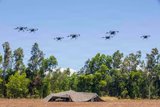
The USCG contract with Shield AI will last for five years. (Image: Shield AI)
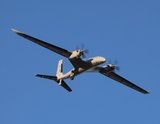
The V-BAT series aircraft is a single-engine ducted fan platform that can launch and recover from a hover and fly on wing in horizontal flight. It can operate as a flexible platform capable of performing Group 2 to Group 5 UAS missions and beyond.


Shield AI will provide surveillance services to the US Coast Guard (USCG) under a US$198.1 million contract using its V-BAT vertical take-off and landing (VTOL) UAS.
The deal is an indefinite-delivery, indefinite-quantity firm fixed-price contract to provide Contractor Owned Contractor Operated (COCO) Intelligence, Surveillance and Reconnaissance (ISR) services.
In a statement, the USCG said the UAS would operate from cutters and provide fully automated flight operations. It has a minimum endurance of 12 hours of flight time daily and the ability to provide services 24 hours a day, seven days a week.
The payload will include electro-optical and infrared sensors and communications relays and be capable of providing surveillance, detection, classification and identification for all of the host cutter’s operational missions.
The contract includes installation and de-installation of the UAS capability and pilot and mission training. Initially, the contract will be used to continue UAS capability on the national security cutter class but the contract can be used to support additional cutter classes in the future.
Shephard Defence Insight noted that the contract, which will run until 2029, has been structured as five one-year ordering periods and estimated that the procurement programme would be for up to 396 units.
Related Equipment in Defence Insight



More from Air Warfare
-
![US Army extended-range CUAS missile ramjet work to continue through December 2029]()
US Army extended-range CUAS missile ramjet work to continue through December 2029
Northrop Grumman’s US$18.8 million XRC propulsion contract runs through December 2029, but performance targets and the pathway to operational fielding remain undisclosed.
-
![Saab’s GlobalEye gains ground as Canada’s aircraft procurement tilts towards Europe]()
Saab’s GlobalEye gains ground as Canada’s aircraft procurement tilts towards Europe
Canada’s interest in negotiating a procurement of Saab’s GlobalEye airborne early warning and control aircraft signals its readiness to reduce its reliance on US defence technology as trade tensions with its North American neighbour mount.
-
![US Air Force CCA programme to achieve multiple milestones in the coming months]()
US Air Force CCA programme to achieve multiple milestones in the coming months
The US Air Force is preparing to select mission-autonomy software, fire a missile from the FQ-42 Vengeance and test both CCA designs alongside crewed fighters at 2026 Emerald Flag.
-
![South American EW demand balances capability against cost]()
South American EW demand balances capability against cost
South American air forces are weighing advanced electronic warfare capabilities against limited budgets as Peru selects Viper Shield and BAE Systems targets smaller airborne platforms.