Production begins of first KC-390 destined for Hungary
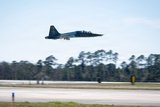
Hungarian government and Embraer representatives attended a ceremony marking the start of production of the first KC-390 for Hungary. (Photo: Embraer)
The first of two KC-390s for Hungary is scheduled for delivery in 2024.


Embraer on 11 November announced that structural assembly work is underway in Brazil of the first in a pair of KC-390 Millennium multi-mission transport aircraft for Hungary, following the conclusion of a critical design review.
The manufacturer noted in a statement: ‘In the coming weeks, parts will be assembled to generate the structural panels and frames for the main components of the fuselage and semi-wings. The first aircraft is scheduled to be delivered in 2024.’
Hungary ordered two KC-390s plus associated services in November 2020 for an undisclosed price, although Shephard Defence Insight calculates a unit price of $85 million for the aircraft.
The fully NATO-compatible KC-390s will not only use a probe and drogue system to refuel Hungarian Air Force JAS 39 Gripen multirole fighter aircraft, but they will also be capable of performing medevac or humanitarian missions with an onboard intensive care unit.
Additional mission types identified by Embraer include troop transport, precision cargo airdrop and paratroop operations.
Brazil (28 aircraft) and Portugal (five) are the only other confirmed customers for the KC-390 to date.
Related Equipment in Defence Insight

You may also like

More from Air Warfare
-
![July drone digest: Sovereign production takes centre stage at Farnborough]()
July drone digest: Sovereign production takes centre stage at Farnborough
Farnborough International Airshow (FIA) 2026 revealed the growing scale of the UK’s uncrewed ambitions, with companies showcasing new CCA, autonomous wingmen and surveillance drones, while sovereign production emerged as a key factor for multiple programmes.
-
![July air forces review: Farnborough steals the headlines as programmes develop]()
July air forces review: Farnborough steals the headlines as programmes develop
The biannual Farnborough International Airshow 2026 was the backdrop in July for scores of deals, partnerships and announcements, including developments in the multinational next-generation Global Combat Air Programme and the UK’s $486 million trainer aircraft requirement.
-
![Maximise survivability with advanced electronic warfare (video)]()
Maximise survivability with advanced electronic warfare (video)
BAE Systems’ all-digital EW delivers 360-degree threat awareness in contested environments, boosts survivability, and cuts lifecycle costs.
-
![US Air Force seeks avionics upgrades for ageing T-38 Talon as T-7A Red Hawk delays persist]()
US Air Force seeks avionics upgrades for ageing T-38 Talon as T-7A Red Hawk delays persist
The USAF is looking for commercial avionics solutions to improve the T-38 Talon’s reliability, readiness and flight safety as continued T-7A Red Hawk delays increase the likelihood that the legacy trainer will remain in service longer than planned.
-
![British Army’s Project Corvus selection highlights new era of drone sovereignty]()
British Army’s Project Corvus selection highlights new era of drone sovereignty
The UK’s choice of the Tekever AR5 for Project Corvus reflects a wider shift in military drone procurement towards solutions that centre on sovereignty and domestic production, moving away from overseas reliance.