Lockheed wins $270 million USAF contract for F-22 infrared sensor upgrade
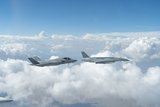
The F-22A Raptor aircraft is currently undergoing upgrades to boost its in-service life. (Photo: USAF)
Tactical Infrared Search and Track (TacIRST) sensors will be installed to boost the fighter’s survivability and lethality.


Lockheed Martin has won a US$270 million contract from the US Air Force (USAF) to integrate a system of next-generation infrared defensive sensors onto the F-22 Raptor.
The Tactical Infrared Search and Track (TacIRST) sensors, also known as the Infrared Defensive System (IRDS), are an integrated solution developed by Lockheed. According to the company, they work to detect airborne threats with greater precision, as well as enhance the aircraft’s survivability and lethality.
Lockheed will also reportedly support the integration of this technology on other platforms. As of 2022, it was already deployed on F-5 Tiger jets who tested the TacIRST.
Related Articles
RTX Raytheon wins billion-dollar contract for F-22 sensors
Hank Tucker, VP of missions systems at Lockheed Martin, said: “We understand the need for advanced and versatile infrared systems like IRDS that will make pilots’ missions more survivable and lethal against current and future adversaries.
“We’re committed to supporting the Air Force through continuous innovation of capabilities to deter and defeat evolving threats.”
This contract joins a wider set of upgrades for the USAF’s F-22 Raptor aircraft to extend its service life. In September 2024, RTX was awarded a US$1 billion contract to upgrade the F-22’s sensors on 154 of its aircraft.
The F-22A Raptor is a fifth-generation stealth, air superiority fighter. With these future upgrades, it is expected to be in service with the USAF until the mid-2050s.
Related Equipment in Defence Insight


More from Air Warfare
-
![October crewed air review: Israel’s Apache deal bets on crewed aviation in an uncrewed age]()
October crewed air review: Israel’s Apache deal bets on crewed aviation in an uncrewed age
Israel’s $1 billion Apache helicopter order highlights the continued demand for crewed attack aviation, while growing integration with uncrewed systems could shape future modernisation and procurement decisions.
-
![Connecting the layers: how networks can secure the future of European air defence]()
Connecting the layers: how networks can secure the future of European air defence
The rise of drones has reshaped the threat landscape for all European militaries. For industry, future defensive strategies must carefully balance a mix of passive and active measures to address the evolving danger, based around a highly integrated and responsive network of sensors and effectors.
-
![October drone digest: France and Lithuania advance loitering munition procurements as global spending surges]()
October drone digest: France and Lithuania advance loitering munition procurements as global spending surges
Recent procurement developments in France and Lithuania highlight the growing demand for loitering munitions, with global annual spending forecast to increase nearly 50-fold between 2020 and 2029.
-
![Quantum Systems details 480km/h Ukrainian interceptor as production scales up]()
Quantum Systems details 480km/h Ukrainian interceptor as production scales up
Quantum Systems’s Ukraine-made interceptor SPYS is thought to cost approximately 10 times less than Russia's jet-powered uncrewed aerial systems and is being produced at scale.