Leonardo and Textron pitch M-346N for upcoming US Navy T-45 replacement
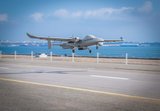
The M-346N would receive some minor tweaks and additional capabilities to support at-sea training operations. (Photo: Leonardo)
Leonardo and Textron’s joint effort to introduce the M-346N aircraft into the US Navy’s training programme has promised to offer a proven efficient training enterprise as the T-45 replacement.


A collaboration between Leonardo and Textron could offer a “no-drama” and “low-risk” solution for the US Navy’s (USN) Undergraduate Jet Training System (UJTS) competition to replace the troubled T-45 Goshhawk trainer, company representatives told Shephard in a recent interview.
FY2025 navy budget documents, released last month, alongside an unofficial Request for Proposal (RFP), indicated that the service could start buying replacement jet trainers in 2026. An official RFP could be released at the end of 2024 or early next year.
Leonardo and Textron Aviation Defense have offered the naval version of the M-346 aircraft, dubbed M-346N, the only twin-engine solution
Our news & analysis is now part of Defence Insight®
A Basic-level or higher Defence Insight subscription is now required to view this content.


More from Air Warfare
-
![July drone digest: Sovereign production takes centre stage at Farnborough]()
July drone digest: Sovereign production takes centre stage at Farnborough
Farnborough International Airshow (FIA) 2026 revealed the growing scale of the UK’s uncrewed ambitions, with companies showcasing new CCA, autonomous wingmen and surveillance drones, while sovereign production emerged as a key factor for multiple programmes.
-
![FIA 2026: Bell highlights MOSA-driven growth path for MV-75 Cheyenne]()
FIA 2026: Bell highlights MOSA-driven growth path for MV-75 Cheyenne
Bell Flight’s modular open-systems approach for the US Army’s MV-75 Cheyenne could open doors for international allies and suppliers once locked out by closed rotorcraft architectures.
-
![Maximise survivability with advanced electronic warfare (video)]()
Maximise survivability with advanced electronic warfare (video)
BAE Systems’ all-digital EW delivers 360-degree threat awareness in contested environments, boosts survivability, and cuts lifecycle costs.
-
![US Air Force seeks avionics upgrades for ageing T-38 Talon as T-7A Red Hawk delays persist]()
US Air Force seeks avionics upgrades for ageing T-38 Talon as T-7A Red Hawk delays persist
The USAF is looking for commercial avionics solutions to improve the T-38 Talon’s reliability, readiness and flight safety as continued T-7A Red Hawk delays increase the likelihood that the legacy trainer will remain in service longer than planned.
-
![British Army’s Project Corvus selection highlights new era of drone sovereignty]()
British Army’s Project Corvus selection highlights new era of drone sovereignty
The UK’s choice of the Tekever AR5 for Project Corvus reflects a wider shift in military drone procurement towards solutions that centre on sovereignty and domestic production, moving away from overseas reliance.