Germany green-lights Israel’s use of Heron TP combat UAV on Hamas
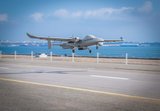
The Bundestag has spent $161.1 million to arm the Heron TPs with 140 bespoke precision-guided missiles. (Photo: German MoD/Twitter)
The Heron TP UAVs Germany is leasing from Israel’s IAI are likely equipped with precision-guided missiles designed for rapid and spatially limited effect against vehicles or positions.


Germany has reportedly given Israel permission to use two of its Heron TP medium-altitude long-endurance (MALE) combat UAVs in its counterattack against Hamas.
Germany’s Airbus DS has signed a $600 million leasing agreement with Israeli weapon maker IAI for five Heron TP for the Germany MoD’s use. The contract is for nine years and has options for content expansion, including extending the lease period by a maximum of another three years. The UAVs are currently known to be deployed at the Israeli Palmahim Air Base.
As first reported by Spiegel, on 11 October, German Defence Minister Boris Pistorius approved a request
Our news & analysis is now part of Defence Insight®
A Basic-level or higher Defence Insight subscription is now required to view this content.





More from Air Warfare
-
![FIA 2026: Bell highlights MOSA-driven growth path for MV-75 Cheyenne]()
FIA 2026: Bell highlights MOSA-driven growth path for MV-75 Cheyenne
Bell Flight’s modular open-systems approach for the US Army’s MV-75 Cheyenne could open doors for international allies and suppliers once locked out by closed rotorcraft architectures.
-
![Maximise survivability with advanced electronic warfare (video)]()
Maximise survivability with advanced electronic warfare (video)
BAE Systems’ all-digital EW delivers 360-degree threat awareness in contested environments, boosts survivability, and cuts lifecycle costs.
-
![US Air Force seeks avionics upgrades for ageing T-38 Talon as T-7A Red Hawk delays persist]()
US Air Force seeks avionics upgrades for ageing T-38 Talon as T-7A Red Hawk delays persist
The USAF is looking for commercial avionics solutions to improve the T-38 Talon’s reliability, readiness and flight safety as continued T-7A Red Hawk delays increase the likelihood that the legacy trainer will remain in service longer than planned.
-
![British Army’s Project Corvus selection highlights new era of drone sovereignty]()
British Army’s Project Corvus selection highlights new era of drone sovereignty
The UK’s choice of the Tekever AR5 for Project Corvus reflects a wider shift in military drone procurement towards solutions that centre on sovereignty and domestic production, moving away from overseas reliance.