Force integration training during Exercise Red Flag


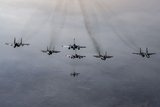
US Air Force F-35A Lightning II aircraft provided the core wing function during Exercise Red Flag.
The large force exercise brought together air and ground units from across the US Air Force, US Navy, Royal Air Force and Royal Australian Air Force for combat training.
As the core wing, the US Air Force’s 388th Fighter Wing acted as the hub for integration, support and resources for the deployed force.
Royal Air Force 617 Squadron from RAF Marham also deployed F-35B for Red Flag, enabling integration and process implementation for cross-servicing maintenance activities between partner nations.
Red Flag offered a chance for force integration combat training, with the Nevada Test and Training Range hosting both integrated air defences with early warning systems and advanced surface-to-air threats. ‘Red force’ aggressor pilots flew aircraft which simulated real-world enemy aircraft to enable ‘blue force’ assets to experience challenging missions in a variety of different scenarios.
Col Steven Behmer, 388th Fighter Wing commander, said: ‘Red Flag gives us, especially our young pilots and maintainers, many of whom have never been down range, the opportunity to experience a joint, deployed environment. We don’t simply learn how to execute the mission, we also get to know each other better, how we work, and succeed together.’
Related Equipment in Defence Insight

You may also like
More from Air Warfare
-
![October crewed air review: Israel’s Apache deal bets on crewed aviation in an uncrewed age]()
October crewed air review: Israel’s Apache deal bets on crewed aviation in an uncrewed age
Israel’s $1 billion Apache helicopter order highlights the continued demand for crewed attack aviation, while growing integration with uncrewed systems could shape future modernisation and procurement decisions.
-
![US Navy keeps Super Hornet production restart option open, but without defined cost or timetable]()
US Navy keeps Super Hornet production restart option open, but without defined cost or timetable
The US Navy plans to preserve Super Hornet and Growler tooling as production winds down, with restart costs unassessed and final F/A-18 deliveries expected in late 2027.
-
![Connecting the layers: how networks can secure the future of European air defence]()
Connecting the layers: how networks can secure the future of European air defence
The rise of drones has reshaped the threat landscape for all European militaries. For industry, future defensive strategies must carefully balance a mix of passive and active measures to address the evolving danger, based around a highly integrated and responsive network of sensors and effectors.
-
![October drone digest: France and Lithuania advance loitering munition procurements as global spending surges]()
October drone digest: France and Lithuania advance loitering munition procurements as global spending surges
Recent procurement developments in France and Lithuania highlight the growing demand for loitering munitions, with global annual spending forecast to increase nearly 50-fold between 2020 and 2029.
-
![Germany could secure greater influence through sixth-generation fighter partnership with Sweden and Spain]()
Germany could secure greater influence through sixth-generation fighter partnership with Sweden and Spain
Germany is assessing potential pathways for a future sixth-generation fighter capability, including discussions with GCAP partners and Sweden.
-
![Quantum Systems details 480km/h Ukrainian interceptor as production scales up]()
Quantum Systems details 480km/h Ukrainian interceptor as production scales up
Quantum Systems’s Ukraine-made interceptor SPYS is thought to cost approximately 10 times less than Russia's jet-powered uncrewed aerial systems and is being produced at scale.