First Loyal Wingman fuselage assembly complete
An Australian industry team has completed major fuselage structural assembly for the first Loyal Wingman, Boeing Australia announced on 10 February.
The aircraft is one of three prototypes that will be developed as a part of the Loyal Wingman – Advanced Development programme in partnership with the Royal Australian Air Force.
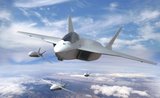
The 38ft (11.7m) aircraft is being designed to use artificial intelligence technology to team with other manned and unmanned platforms.
This first prototype will inform production of the Airpower Teaming System (ATS), which Boeing Australia is developing for the global defence market. Customers will be able to tailor ATS sensors and systems based on their own defence and industrial objective.
The Boeing Australian industry team includes BAE Systems Australia, RUAG Australia, Ferra Engineering and AME Systems.
The next major milestone will be weight on wheels, when the fuselage structure moves from the assembly jig to the aircraft’s own landing gear to continue systems installation and functional testing. The aircraft is expected to complete its first flight this year.
Shane Arnott, program director, Boeing ATS, said: ‘This is an exciting milestone for the development programme, and the Australian aerospace industry, as we progress with production of the first military aircraft to be developed in Australia in more than 50 years.’
Related Programmes in Defence Insight
Related Equipment in Defence Insight



You may also like

More from Air Warfare
-
![Saab’s flight-tested AI agents signal new era of crewed-uncrewed fighter systems]()
Saab’s flight-tested AI agents signal new era of crewed-uncrewed fighter systems
Saab is developing artificial intelligence (AI) agents for crewed and uncrewed aircraft, targeting potential operational deployment within months, while expanding its training capabilities, partnerships and ambitions for wider military applications.
-
![October crewed air review: Israel’s Apache deal bets on crewed aviation in an uncrewed age]()
October crewed air review: Israel’s Apache deal bets on crewed aviation in an uncrewed age
Israel’s $1 billion Apache helicopter order highlights the continued demand for crewed attack aviation, while growing integration with uncrewed systems could shape future modernisation and procurement decisions.
-
![US Navy keeps Super Hornet production restart option open, but without defined cost or timetable]()
US Navy keeps Super Hornet production restart option open, but without defined cost or timetable
The US Navy plans to preserve Super Hornet and Growler tooling as production winds down, with restart costs unassessed and final F/A-18 deliveries expected in late 2027.
-
![Connecting the layers: how networks can secure the future of European air defence]()
Connecting the layers: how networks can secure the future of European air defence
The rise of drones has reshaped the threat landscape for all European militaries. For industry, future defensive strategies must carefully balance a mix of passive and active measures to address the evolving danger, based around a highly integrated and responsive network of sensors and effectors.
-
![October drone digest: France and Lithuania advance loitering munition procurements as global spending surges]()
October drone digest: France and Lithuania advance loitering munition procurements as global spending surges
Recent procurement developments in France and Lithuania highlight the growing demand for loitering munitions, with global annual spending forecast to increase nearly 50-fold between 2020 and 2029.
-
![Germany could secure greater influence through sixth-generation fighter partnership with Sweden and Spain]()
Germany could secure greater influence through sixth-generation fighter partnership with Sweden and Spain
Germany is assessing potential pathways for a future sixth-generation fighter capability, including discussions with GCAP partners and Sweden.