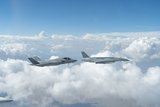
First Brazilian Gripen flown in Brazil


The first Brazilian Gripen E has concluded its first flight in Brazil, manufacturer Saab announced on 24 September.
The aircraft, designated by the Brazilian Air Force (FAB) as the F-39 Gripen, flew from the airport in Navegantes to Embraer´s facility in Gavião Peixoto.
The official presentation of the aircraft is scheduled to take place during Aviator’s Day and the Brazilian Air Force Day ceremony in Brasilia on 23 October.
The Brazilian Minister of Defence, Fernando Azevedo e Silva, highlighted the importance of the cooperation between Brazil and Sweden:
‘Gripen increases the operational capacity of the Brazilian Air Force and promotes a partnership that fosters research and industrial development in both countries,’ the minister declared.
The FAB commander, Lt. Brig. Antonio Carlos Moretti Bermudez, said the arrival of the first F-39 Gripen aircraft was a major milestone for the project.
‘It is an immense satisfaction for the Brazilian Air Force to see this aircraft flying on national territory. The F-39 Gripen, the new Brazilian Air Force multi-mission aircraft, will be the backbone of Fighter Aviation and it reaffirms the FAB’s commitment to maintaining the country’s sovereignty and to defend the 22 million square kilometres under its responsibility.’
The flight test programme will now be expanded to include the Gripen Flight Test Center at Embraer in Gavião Peixoto, which will be fully integrated with the test programme already running at full phase at Saab in Linköping since 2017.
Activities in Brazil will include testing of the flight control system and environmental control system as well as tests in the aircraft in tropical climate conditions. In addition unique features of the Brazilian aircraft, such as weapons integration as well as the Link BR2 communication system - which provides encrypted data and voice communication between the aircraft - will be tested in Brazil.
The production aircraft will be delivered to the Brazilian Air Force, at Wing 2 in Anápolis (Goiás State), by the end of 2021.
The partnership with Brazil began in 2014 with a contract for the development and the production of 36 Gripen E/F aircraft for the Brazilian Air Force, including related systems, support and equipment.
As of 2021, the complete assembly of 15 aircraft will commence locally. The development of the two-seat Gripen F is advancing with numerous activities at the Gripen Design and Development Centre (GDDN) in Gavião Peixoto.
As part of our promise to deliver comprehensive coverage to our Defence Insight and Premium News subscribers, our curated defence news content provides the latest industry updates, contract awards and programme milestones.
Related Equipment in Defence Insight

You may also like
More from Air Warfare
-
![October drone digest: France and Lithuania advance loitering munition procurements as global spending surges]()
October drone digest: France and Lithuania advance loitering munition procurements as global spending surges
Recent procurement developments in France and Lithuania highlight the growing demand for loitering munitions, with global annual spending forecast to increase nearly 50-fold between 2020 and 2029.
-
![Germany could secure greater influence through sixth-generation fighter partnership with Sweden and Spain]()
Germany could secure greater influence through sixth-generation fighter partnership with Sweden and Spain
Germany is assessing potential pathways for a future sixth-generation fighter capability, including discussions with GCAP partners and Sweden.
-
![Quantum Systems details 480km/h Ukrainian interceptor as production scales up]()
Quantum Systems details 480km/h Ukrainian interceptor as production scales up
Quantum Systems’s Ukraine-made interceptor SPYS is thought to cost approximately 10 times less than Russia's jet-powered uncrewed aerial systems and is being produced at scale.
-
![UK eyes lightweight satellite communications for UAVs]()
UK eyes lightweight satellite communications for UAVs
The UK is seeking to extend the operational reach of uncrewed aerial vehicles, reflecting growing demand for compact, energy-efficient technology to support beyond-line-of-sight operations.
-
![Loyal wingman programmes gather pace as US and European procurement plans take shape]()
Loyal wingman programmes gather pace as US and European procurement plans take shape
Northrop Grumman, Airbus and Anduril are positioning their uncrewed aerial vehicles for future collaborative combat aircraft contracts in a market that is forecast to exceed $36 billion.