F135 repair and upgrade facility goes operational in Australia
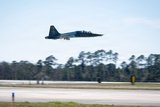
TAE Aerospace will support engines for all F-35 operators in the Asia-Pacific region. (Photo: TAE Aerospace)
TAE Aerospace sets up the first Asia-Pacific engine maintenance depot for F-35 engines.


TAE Aerospace has achieved initial depot capability status to repair Pratt & Whitney F135 engine fan and power modules on all variants of the F-35 Joint Strike Fighter, thereby placing F-35 engine maintenance capability in the Asia-Pacific region for the first time.
As an operational F135 engine depot outside of the US, TAE Aerospace will support engines for all F-35 operators in the Asia-Pacific region under the F-35 Global Support System.
Australia has ordered 72 of the F135 engines, according to Shephard Defence Insight.
The latest development also helps meet Australian government goals of establishing sovereign industrial capabilities, said TAE Aerospace CEO Andrew Sanderson.
O Sung Kwon, VP of Pratt & Whitney Military Engines Sustainment Operations, noted that standing up regional (MRO&U) depots ‘is an integral part of the enterprise’s strategy to accelerate capacity growth across the F135 MRO&U network to exceed programme requirements’.
Since 2015, TAE Aerospace, Pratt & Whitney and the Australian federal government have delivered MRO and upgrade initiatives such as the completion of the first F135 fan module repair (February 2020) and completion of the first F135 power module repair (May 2021) outside the US.
Attributes of the fifth-generation F135 compared with fourth-generation engines include more than 40,000lb of thrust; a 50% increase in thermal management capacity; and a low observable signature enabling the F-35 to conduct operations in modern A2AD environments.
Related Equipment in Defence Insight

You may also like

More from Air Warfare
-
![July drone digest: Sovereign production takes centre stage at Farnborough]()
July drone digest: Sovereign production takes centre stage at Farnborough
Farnborough International Airshow (FIA) 2026 revealed the growing scale of the UK’s uncrewed ambitions, with companies showcasing new CCA, autonomous wingmen and surveillance drones, while sovereign production emerged as a key factor for multiple programmes.
-
![July air forces review: Farnborough steals the headlines as programmes develop]()
July air forces review: Farnborough steals the headlines as programmes develop
The biannual Farnborough International Airshow 2026 was the backdrop in July for scores of deals, partnerships and announcements, including developments in the multinational next-generation Global Combat Air Programme and the UK’s $486 million trainer aircraft requirement.
-
![Maximise survivability with advanced electronic warfare (video)]()
Maximise survivability with advanced electronic warfare (video)
BAE Systems’ all-digital EW delivers 360-degree threat awareness in contested environments, boosts survivability, and cuts lifecycle costs.
-
![US Air Force seeks avionics upgrades for ageing T-38 Talon as T-7A Red Hawk delays persist]()
US Air Force seeks avionics upgrades for ageing T-38 Talon as T-7A Red Hawk delays persist
The USAF is looking for commercial avionics solutions to improve the T-38 Talon’s reliability, readiness and flight safety as continued T-7A Red Hawk delays increase the likelihood that the legacy trainer will remain in service longer than planned.
-
![British Army’s Project Corvus selection highlights new era of drone sovereignty]()
British Army’s Project Corvus selection highlights new era of drone sovereignty
The UK’s choice of the Tekever AR5 for Project Corvus reflects a wider shift in military drone procurement towards solutions that centre on sovereignty and domestic production, moving away from overseas reliance.