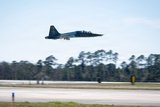
F-35 full-rate production could slip, says DoD
Simulation tests, originally planned for 2017 and rescheduled for December 2020, have been delayed again


Full-rate production of the F-35 Lightning II faces a delay until 2021, following a decision by the DoD to postpone essential simulation tests until then.
Meanwhile, F-35 low-rate initial production will continue ‘in line with congressional authorisation and appropriation’, said Jessica Maxwell, a spokeswoman for Ellen Lord, Under Secretary of Defense for Acquisition and Sustainment.
F-35 simulation tests were due to take place in December 2020 but this is not the first time they have been pushed back, as they were originally scheduled for 2017.
F-35 manufacturer Lockheed Martin acknowledged in July 2020 that an annual target of 141 deliveries could slip by as many as 24 units due to COVID-19 issues and suppliers being unable to maintain timely deliveries.
According to Shephard Defence Insight, the USAF plans to order 1137 F-35As between FY2026 and FY2048; and the USN aims to buy 115 F-35B STOVL variants between FY2026 and FY2031 plus 130 F-35C carrier variants between FY2026 and FY2030.
As part of our promise to deliver comprehensive coverage to our Defence Insight and Premium News subscribers, our curated defence news content provides the latest industry updates, contract awards and programme milestones.
Related Programmes in Defence Insight



More from Air Warfare
-
![July drone digest: Sovereign production takes centre stage at Farnborough]()
July drone digest: Sovereign production takes centre stage at Farnborough
Farnborough International Airshow (FIA) 2026 revealed the growing scale of the UK’s uncrewed ambitions, with companies showcasing new CCA, autonomous wingmen and surveillance drones, while sovereign production emerged as a key factor for multiple programmes.
-
![July air forces review: Farnborough steals the headlines as programmes develop]()
July air forces review: Farnborough steals the headlines as programmes develop
The biannual Farnborough International Airshow 2026 was the backdrop in July for scores of deals, partnerships and announcements, including developments in the multinational next-generation Global Combat Air Programme and the UK’s $486 million trainer aircraft requirement.
-
![Maximise survivability with advanced electronic warfare (video)]()
Maximise survivability with advanced electronic warfare (video)
BAE Systems’ all-digital EW delivers 360-degree threat awareness in contested environments, boosts survivability, and cuts lifecycle costs.
-
![US Air Force seeks avionics upgrades for ageing T-38 Talon as T-7A Red Hawk delays persist]()
US Air Force seeks avionics upgrades for ageing T-38 Talon as T-7A Red Hawk delays persist
The USAF is looking for commercial avionics solutions to improve the T-38 Talon’s reliability, readiness and flight safety as continued T-7A Red Hawk delays increase the likelihood that the legacy trainer will remain in service longer than planned.
-
![British Army’s Project Corvus selection highlights new era of drone sovereignty]()
British Army’s Project Corvus selection highlights new era of drone sovereignty
The UK’s choice of the Tekever AR5 for Project Corvus reflects a wider shift in military drone procurement towards solutions that centre on sovereignty and domestic production, moving away from overseas reliance.