Dutch to receive flaperons for F-16s
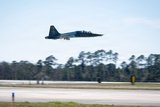
RNLAF F-16AM at Volkel Air Base. (Photo: Netherlands MoD)
Venerable Dutch F-16 fleet will receive new flaperons via the FMS programme.


Aerospace & Commercial Technologies is supplying the Royal Netherlands Air Force (RNLAF) with flaperons to stabilise F-16AM aircraft at low speed during take-off and landing.
The Fort Worth, Texas-based company obtained a sole-source five-year FMS deal worth up to $10.66 million from the Defense Logistics Agency.
Work will be carried out in the Netherlands and US for completion by 26 January 2027.
Shephard Defence Insight notes that the RNLAF ordered a total of 213 F-16A/B Block 1, 5, 10 and 15 aircraft (designated F-16AM) between 1979 and 1989 as one of the original NATO customers.
Most have been sold second-hand to other air forces or private-sector training organisations, but a few dozen remain in service.
However, the F-16AMs will be replaced by 46 F-35As. Deliveries of the F-35A to the Netherlands are underway with 15 in place at Leeuwarden Air Base.
The F-16AM will remain in RNLAF service until 2024-2025, although the term of the flaperon contract suggests an extension beyond that date.
Related Equipment in Defence Insight



More from Air Warfare
-
![July drone digest: Sovereign production takes centre stage at Farnborough]()
July drone digest: Sovereign production takes centre stage at Farnborough
Farnborough International Airshow (FIA) 2026 revealed the growing scale of the UK’s uncrewed ambitions, with companies showcasing new CCA, autonomous wingmen and surveillance drones, while sovereign production emerged as a key factor for multiple programmes.
-
![July air forces review: Farnborough steals the headlines as programmes develop]()
July air forces review: Farnborough steals the headlines as programmes develop
The biannual Farnborough International Airshow 2026 was the backdrop in July for scores of deals, partnerships and announcements, including developments in the multinational next-generation Global Combat Air Programme and the UK’s $486 million trainer aircraft requirement.
-
![Maximise survivability with advanced electronic warfare (video)]()
Maximise survivability with advanced electronic warfare (video)
BAE Systems’ all-digital EW delivers 360-degree threat awareness in contested environments, boosts survivability, and cuts lifecycle costs.
-
![US Air Force seeks avionics upgrades for ageing T-38 Talon as T-7A Red Hawk delays persist]()
US Air Force seeks avionics upgrades for ageing T-38 Talon as T-7A Red Hawk delays persist
The USAF is looking for commercial avionics solutions to improve the T-38 Talon’s reliability, readiness and flight safety as continued T-7A Red Hawk delays increase the likelihood that the legacy trainer will remain in service longer than planned.
-
![British Army’s Project Corvus selection highlights new era of drone sovereignty]()
British Army’s Project Corvus selection highlights new era of drone sovereignty
The UK’s choice of the Tekever AR5 for Project Corvus reflects a wider shift in military drone procurement towards solutions that centre on sovereignty and domestic production, moving away from overseas reliance.