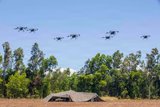
B-2 stealth bomber receives new digital communications system
Northrop Grumman and the USAF continue to modernise the B-2 stealth bomber. (Photo: US DoD)
Northrop Grumman and the USAF have completed an integrated airborne mission transfer (IAMT) demonstrator with the B-2 Spirit at Whiteman Air Force Base.


The demonstration included approximately 50 mission transfers during a two-day period in partnership with the Air Force. A B-2 was configured with the manufacturer’s Multi-Mission Domain (MMD) architecture.
MMD is an open mission system architecture for the aircraft that allows rapid and affordable fielding of modern mission capabilities.
This work is part of ongoing B-2 modernisation efforts that seek to increase the use of digital technologies in the platform.
IAMT provides an enhanced capability, allowing the B-2 to execute digital, machine-to-machine transfers of new missions while in flight, directly integrating them into the aircraft’s systems.
This technology is an integral component of Northrop Grumman‘s B-2 Collaborative Combat Communication (B2C3) Spiral 1 programme, which serves to elevate the stealth bomber’s communication capabilities within the modern battlefield landscape.
‘We are providing the B-2 with the capabilities to communicate and operate in advanced battle management systems and the joint all-domain command and control environment, keeping B-2 ahead of evolving threats,’ said Nikki Kodama, VP and B-2 programme manager at Northrop Grumman.
‘The integration of this digital software with our weapon system will further enhance the connectivity and survivability in highly contested environments as part of our ongoing modernisation effort.’
Modernisation efforts on the Spirit began in 2007 to ensure it remains fully capable against evolving threats.
Northrop Grumman and the USAF announced the continuation of enhancement and modernisation of the B-2 Spirit fleet at the end of last summer, with the new capabilities including long-range stealth missiles.
According to Shephard Defence Insight, the USAF plans to retire the B-2 no later than 2032 due to its operational and maintenance costs.
Related Equipment in Defence Insight



More from Air Warfare
-
![Could the next UAS market boom take place beyond the battlefield?]()
Could the next UAS market boom take place beyond the battlefield?
While the headlines remain dominated by the use of drones for combat operations in Ukraine and other conflicts, there are emerging use cases where the technology could usefully feed back into areas and missions outside the war zone.
-
![USAF eyes sensor and weapon upgrades as MH-139A Grey Wolf achieves IOC]()
USAF eyes sensor and weapon upgrades as MH-139A Grey Wolf achieves IOC
The Grey Wolf has entered operational service nearly three years later than originally planned, while new sustainment contracts indicate that some UH-1Ns could remain supported until 2031.
-
![Extending mission readiness: where XR adds real value in pilot, crew and maintenance training]()
Extending mission readiness: where XR adds real value in pilot, crew and maintenance training
Extended reality (XR) is becoming increasingly relevant in military aviation training, adding a flexible layer to an integrated ecosystem spanning the pilot, crew, and maintenance domains.
-
![US military tests AI-powered CUAS turret against drone swarms]()
US military tests AI-powered CUAS turret against drone swarms
As the US continues to invest heavily in counter-drone systems, demand for low-cost, mobile and autonomous technologies is on the rise, with Edda designed to align with these emerging requirements.