USS Jackson completes acceptance trials
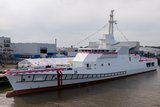
The US Navy’s future USS Jackson Littoral Combat Ship (LCS) has completed sea acceptance trials, the Naval Sea Systems Command announced on 30 June.
The acceptance trials concluded on 26 June after the completion of in-port and underway graded demonstrations for the navy’s board of inspection and survey. The final delivery of the ship will take place later in the summer.
The ship’s handling, propulsion plant and auxiliary systems were demonstrated in the trials, which lasted five days. In the underway part of its trials the ship successfully launched and recovered its 11m rigid hull inflatable boat. It also conducted a full power run, surface and air detect-to-engage exercises and achieved speeds greater than 40 knots.
The USS Jackson (LCS 6) will be commissioned in December and will have San Diego, California as its home port, along with its sister ships USS Freedom (LCS 1), USS Independence (LCS 2), USS Fort Worth (LCS 3) and USS Coronado (LCS 4).




More from Naval Warfare
-
![AUKUS heavyweight torpedo test raises questions over future armed UUV requirements]()
AUKUS heavyweight torpedo test raises questions over future armed UUV requirements
A heavyweight torpedo firing from the Royal Navy’s uncrewed submarine XV Excalibur suggests a shift beyond surveillance, with allied navies eyeing strike roles for large autonomous undersea vessels.
-
![Industrial teams prepare roadmap for Indonesia aircraft carrier transformation]()
Industrial teams prepare roadmap for Indonesia aircraft carrier transformation
Fincantieri and PT PAL have agreed on a framework to modernise the former Giuseppe Garibaldi, with drones, communications and broader Italian–Indonesian industrial ties involved.
-
![Five years on: where could opportunities emerge next for AUKUS Pillar II?]()
Five years on: where could opportunities emerge next for AUKUS Pillar II?
Payload commonality, combat systems and electronic warfare are emerging as likely priorities as the trilateral partnership balances building submarines with sharing industrial ecosystems.