USN issues contract modification for submarine missile guidance technologies
Deal covers hypersonic guidance, navigation and control applications for the Common Missile Compartment


The USN Strategic Systems Programs office has awarded the Charles Stark Draper Laboratory a $133.47 million contract modification to research potential applications of guidance technologies for submarines.
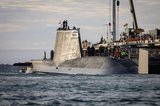
The modification covers the Common Missile Compartment for the Trident II D5 submarine-launched ICBM in the USN Columbia-class programme and the Dreadnought-class programme (pictured) for the UK RN.
Charles Stark Draper Laboratory will provide specialised technical knowledge and support for the hypersonic guidance, navigation and control application.
It will also supply technical and engineering services to support the guidance, navigation and control system that will support USN hypersonic flight experiments.
Work will be performed in Cambridge, Massachusetts (81%) and El Segundo, California (19%), with an expected completion date of 30 September 2021.
As part of our promise to deliver comprehensive coverage to our Defence Insight and Premium News subscribers, our curated defence news content provides the latest industry updates, contract awards and programme milestones.
Related Programmes in Defence Insight




More from Naval Warfare
-
![Five years on: where could opportunities emerge next for AUKUS Pillar II?]()
Five years on: where could opportunities emerge next for AUKUS Pillar II?
Payload commonality, combat systems and electronic warfare are emerging as likely priorities as the trilateral partnership balances building submarines with sharing industrial ecosystems.
-
![Singapore expands maritime presence with future-ready Sentinel OPV]()
Singapore expands maritime presence with future-ready Sentinel OPV
Singapore is building space for uncrewed systems and future technologies into its new Sentinel-class OPVs, reflecting a wider move towards adaptable vessels capable of maintaining persistent maritime presence.
-
![From the Baltic to the Gulf: where USV procurement is heading next]()
From the Baltic to the Gulf: where USV procurement is heading next
Saildrone’s new Copenhagen base is one sign of a larger shift, as navies globally turn to uncrewed vessels for surveillance and mine clearance.
-
![Israeli Navy looks to expand as war reshapes future force requirements]()
Israeli Navy looks to expand as war reshapes future force requirements
Israel’s navy is preparing for a larger and more technically diverse role, but its ambitions could be impacted by supply chain restrictions, accelerating demand for domestic naval production as well as autonomous maritime capabilities.
-
![Quantum sensing gathers pace as navies eye undersea advantage]()
Quantum sensing gathers pace as navies eye undersea advantage
As AI dominates defence conversations, industry increasingly points to quantum sensing as the technology set to change submarine and uncrewed underwater vehicle operations.