VIDEO: US Navy footage shows 'unsafe' manoeuvres by Chinese ship
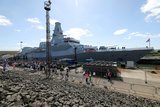
The Chinese destroyer was pictured crossing the bow of the US ship. (Photo: USN)
The USN has released footage of a Chinese ship Type-052D destroyer crossing the bow of an Arleigh Burke-class destroyer during a routine transit of the Taiwan Strait.


On 3 June, while sailing south to north through the contested strait, the Chinese destroyer crossed the bow of USS Chung-Hoon at a distance of a little over 137m.
In the video, the Chinese ship can be seen crossing the bow of the US vessel.
In a 3 June statement, US Indo-Pacific Command said: 'In accordance with international law, USS Chung-Hoon (DDG 93) and HMCS Montreal (FFH 336) conducted a routine south to north Taiwan Strait transit 3 June through waters where high seas freedoms of navigation and overflight apply.
'During the transit, PLA(N) Luyang III DDG 132 (PRC LY 132) executed manoeuvres in an unsafe manner in the vicinity of Chung-Hoon.'
Later, the Chinese ship crossed the US destroyer's bow a second time at a distance of 1.82km.
The USN said the closest approach violated the maritime 'rules of the road' of safe passage in international waters.

You may also like
More from Naval Warfare
-
![RTX Raytheon enhances SM-3 and SM-6 production capacity]()
RTX Raytheon enhances SM-3 and SM-6 production capacity
The expansion of the Redstone facility in Alabama will enable Raytheon to increase production of Standard Missiles in the location by 50% and support Washington in refilling stockpiles after recent operations have depleted the Pentagon’s reserves.
-
![What the rise of interoperability between Western allies means for defence procurement]()
What the rise of interoperability between Western allies means for defence procurement
Major naval initiatives including the European Patrol Corvette programmes and Norway’s UK partnership-focused purchase of Type 26 frigates point to the growing interest in the advantages of commonality across allied navies.
-
![Kraken’s Royal Navy USV contract signals next step in crewed-uncrewed integration]()
Kraken’s Royal Navy USV contract signals next step in crewed-uncrewed integration
The UK Royal Navy’s rapid procurement of uncrewed platforms aligns with the force’s strategic shift towards a fleet better equipped to handle modern threats.
-
![HMS Anson’s milestone stay in Australia cut short during AUKUS deployment]()
HMS Anson’s milestone stay in Australia cut short during AUKUS deployment
The Astute-class submarine’s visit to Australia was the first time maintenance activity on a UK Royal Navy nuclear submarine had been carried out in the country.
-
![How Operation Epic Fury could reduce US readiness to face China]()
How Operation Epic Fury could reduce US readiness to face China
The offensive against Iran could impact training and maintenance cycles and accelerate the degradation of the US arsenal on top of depleting Washington’s stockpiles.
-
![UK Royal Navy explores modular counter-drone capabilities for future hybrid fleet]()
UK Royal Navy explores modular counter-drone capabilities for future hybrid fleet
The UK MoD is scoping out systems to counter the growing threat of uncrewed aerial systems, with a focus on low-cost modularity and speed to field.