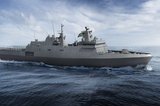
US Navy developing new MVSOT solutions


The US Naval Surface Warfare Center Panama City Division (NSWC PCD) is developing a new non-lethal tool designed to slow down or stop on-coming target vessels.
The Maritime Vessel Stopping Occlusion Technologies (MVSOT) uses technologies that limit or remove the ability of a propulsion system to provide thrust to a boat, but in a reversible manner.
The MVSOT programme is currently testing commercially available drogue lines for a near term solution. These drogue lines use lengths of rope with sea anchors to restrict forward momentum of a target boat using drag forces. Testing to date has shown these products to be repeatable and reliable, although limited to only certain vessel types.
The programme is also developing next generation occlusion materials for an all-in-one solution. These materials include synthetic hagfish slime and spider silk proteins, which lend advanced swelling, adhesive, and strength properties not available in current commercial products.
Michelle Kincer, NSWC PCD materials engineer, said: ‘These technologies are persistent but reversible, allowing the warfighter increased stand-off time and distance to de-escalate a potentially threatening situation. MVSOT solutions may provide the warfighter a new capability for their toolkit which will allow them more time to ascertain the intent of an oncoming vessel.’
As these next generation solutions develop, the MVSOT team will look to integrate the different materials in a total solution package and test in scaled test tanks as well as in-water at-sea testing.

More from Naval Warfare
-
![Seoul’s SSN programme launch raises questions on fuel, tech and build location]()
Seoul’s SSN programme launch raises questions on fuel, tech and build location
Seoul has unveiled its “Jangbogo-N Project” to develop domestically built, nuclear-propelled attack submarines in close coordination with Washington, marking an escalation of the Republic of Korea’s deterrence posture against Pyongyang’s undersea nuclear capabilities.
-
![Tokyo’s naval export drive gains strategic depth in Southeast Asia]()
Tokyo’s naval export drive gains strategic depth in Southeast Asia
Indonesia’s consideration of Mogami-class frigates points to a widening export opportunity for Tokyo across Southeast Asia and raises the prospect of the Mogami becoming the region’s default mid-tier surface combatant.
-
![Frigates and submarines anchor Brazilian naval modernisation worth US$5.52 billion]()
Frigates and submarines anchor Brazilian naval modernisation worth US$5.52 billion
Shipbuilding programmes established over the past decade are setting Brazil's course towards having one of the most modern navies in the region.