Ulaq progress continues with first live firing test
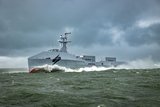
The Ulaq USV pictured during tests on 26-27 May. (Photo: Ares Shipyard)
Turkish USV fires laser-guided missiles at a stationary target.


The Ulaq armed unmanned surface vessel (USV) reached an important milestone recently with two tests on 26-27 May.
The first test was held to validate the systems and rehearse for the initial firing test the following day, when Ulaq successfully engaged a stationary target with two laser-guided Cirit missiles over a distance of 4km.
Cirit is a 70mm missile designed by Roketsan to hit stationary or moving unarmoured or lightly armoured targets. The missile weighs 15km has a maximum range of 8km, according to Shephard Defence Insight.
Ulaq is private development by Turkish companies Meteksan Defense and Ares Shipyard. The
Our news & analysis is now part of Defence Insight®
A Basic-level or higher Defence Insight subscription is now required to view this content.
More from Naval Warfare
-
![Competitive P17B tender marks a shift in Indian Navy frigate procurement]()
Competitive P17B tender marks a shift in Indian Navy frigate procurement
The Indian Navy's P17B programme is expected to combine greater weapons capacity with a competitive domestic construction model, although key systems could remain dependent on international supply chains.
-
![How France’s SNLE 3G programme is reshaping the naval nuclear industrial base]()
How France’s SNLE 3G programme is reshaping the naval nuclear industrial base
Extending far beyond a four-submarine replacement programme, France’s ballistic missile submarine effort is a decades-long industrial initiative designed to preserve the country’s ability to build and sustain nuclear-powered strategic platforms.
-
![China’s mineral processing dominance exposes naval supply chain vulnerabilities]()
China’s mineral processing dominance exposes naval supply chain vulnerabilities
Competition for critical minerals, and China’s dominance of their processing, is emerging as a decisive factor in future naval procurement programmes.
-
![Suppliers await next step in Australia’s mine warfare transition]()
Suppliers await next step in Australia’s mine warfare transition
Australia’s mine countermeasure capability remains in flux as the Huon-class nears retirement, but accelerated investment in autonomous systems is opening a path for industry.
-
![Can the US Navy ask Indo-Pacific allies to do more while training with them less?]()
Can the US Navy ask Indo-Pacific allies to do more while training with them less?
As the Iran War draws US ships and marine corps units away from the Indo-Pacific, curtailed exercises and a temporary carrier gap are exposing tensions between Washington’s demand for more self-reliant allies and the joint training needed to realise that ambition.