Turkey orders Roll-Royce’s MTU engines


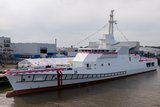
Rolls-Royce will supply MTU diesel engines for six new search and rescue (SAR) vessels being built by Damen Shipyards for the Turkish Coast Guard, the company announced on 19 January.
The International Organisation for Migration awarded a contract to Damen Shipyards to build the SAR vessels in November 2016. Each will be powered by two eight-cylinder MTU Series 2000 engines. The first of the six vessels is expected to be delivered in May 2017 and the remainder by the end of the year.
The vessels will assist SAR operations along the Turkish coast. They are designed to be self-righting; should they capsize, the MTU engines will keep on running even in the extreme event that the vessel completes a full 360° vertical roll around its longitudinal axis.
The vessels are designed and equipped to operate as lifeboats and the aluminium hull is based on Damen’s axe-bow technology. The MTU 8V 2000 M84L engines enable a top speed of 33 knots for SAR operations.
Knut Müller, head of the marine and government business division at MTU, said: ‘We have designed our engines specifically for such difficult operational conditions, including the unlikely event of capsizing. They are equipped with a special kit, which ensures that there is sufficient oil available to coat the engine parts with a film of lubricant.’


More from Naval Warfare
-
![Five years on: where could opportunities emerge next for AUKUS Pillar II?]()
Five years on: where could opportunities emerge next for AUKUS Pillar II?
Payload commonality, combat systems and electronic warfare are emerging as likely priorities as the trilateral partnership balances building submarines with sharing industrial ecosystems.
-
![From the Baltic to the Gulf: where USV procurement is heading next]()
From the Baltic to the Gulf: where USV procurement is heading next
Saildrone’s new Copenhagen base is one sign of a larger shift, as navies globally turn to uncrewed vessels for surveillance and mine clearance.
-
![Quantum sensing gathers pace as navies eye undersea advantage]()
Quantum sensing gathers pace as navies eye undersea advantage
As AI dominates defence conversations, industry increasingly points to quantum sensing as the technology set to change submarine and uncrewed underwater vehicle operations.