Tsirkon series production begins
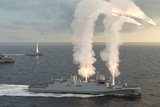
Admiral Gorshkov test-fires Tsirkon. (Photo: Russian MoD/TASS)
The Russian Navy awaits Tsirkon hypersonic missile deliveries in 2022.


NPO Mashinostroyeniya has begun serial production of the Tsirkon ship-launched hypersonic cruise missile for the Russian Navy, state-run news agency TASS reported on 30 November.
A Russian MoD source told TASS that batch production is underway, ‘although acceptance trials of the missile from a surface warship will continue’.
Acceptance trials include five test launches at sea and coastal targets. The Project 22350 frigate Admiral Gorshkov fired test-fired Tsirkon since 2019 in the Barents Sea and the same vessel conducted the most recent successful test launch on 18 November 2021.
The MoD signed a contract to obtain an undisclosed number of Tsirkon missiles in August 2021 during the Army-2021 trade show, and Russian President Vladimir Putin said on 3 November that the hypersonic weapon would be delivered to the Russian Navy in 2022.
Related Equipment in Defence Insight


More from Naval Warfare
-
![Suppliers await next step in Australia’s mine warfare transition]()
Suppliers await next step in Australia’s mine warfare transition
Australia’s mine countermeasure capability remains in flux as the Huon-class nears retirement, but accelerated investment in autonomous systems is opening a path for industry.
-
![Can the US Navy ask Indo-Pacific allies to do more while training with them less?]()
Can the US Navy ask Indo-Pacific allies to do more while training with them less?
As the Iran War draws US ships and marine corps units away from the Indo-Pacific, curtailed exercises and a temporary carrier gap are exposing tensions between Washington’s demand for more self-reliant allies and the joint training needed to realise that ambition.
-
![How could Rheinmetall’s GMF 140 fit with ongoing programmes in North America?]()
How could Rheinmetall’s GMF 140 fit with ongoing programmes in North America?
With Canada committed to its River-class replacement and the USN pursuing a lower-cost frigate, Rheinmetall will need to demonstrate where the GMF 140 can fill a capability gap in the North American fleet.
-
![Australian industry programme builds pipeline for Virginia-class sustainment]()
Australian industry programme builds pipeline for Virginia-class sustainment
Australian businesses can now bid to support Virginia-class submarine sustainment in Western Australia, as momentum around the Henderson Defence Precinct also builds.
-
![South Korea, Japan and Turkey vie for US shipbuilding access in future frigate contest]()
South Korea, Japan and Turkey vie for US shipbuilding access in future frigate contest
Washington’s search for a foreign-built frigate could hand South Korea, Japan and Turkey a larger prize than a double-hull order: a foothold inside the US shipbuilding industrial base.
-
![Japan’s FY2027 budget bets on stand-off systems to offset demographic decline]()
Japan’s FY2027 budget bets on stand-off systems to offset demographic decline
Japan’s FY2027 defence budget backs stand-off strike, a 17-aircraft MQ-9B buy and a declared bid to lead the world in uncrewed maritime assets, alongside new frigates, submarines and support ships.