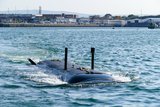
Thales facility in Spain produces underwater telephone
Computer-generated image of the F-110 frigate design. (Photo: Navantia)
Spanish F110 frigates to benefit from TUUM-6 digital communication system


The Spanish subsidiary of Thales has begun production of the TUUM-6 underwater communication system, to be provided for five new Spanish Navy Bonifaz-class (F-110) frigates under a contract signed in December 2019.
Thales is also producing the CAPTAS 4 Compact and the BlueMaster anti-submarine warfare sonar systems for the F-110 vessels under that contract.
TUUM-6 is the first naval system produced near Madrid at Thales Leganés, where it complements the current production of the DKU aeronautical unit for NH90 helicopters and various military radio communications devices for the Spanish Army.
‘The contract, the transfer of know-how from the parent company and the start-up of production of the TUUM-6 represent a… clear demonstration of the company’s commitment to increasing industrial production in Spain,’ Thales stated on 16 June.
The F-110 frigates are expected to displace 6,100t with a length of 145m, a beam of 18.6m and a draft of 4.95m. The first frigate is expected to be delivered in 2025 and deployed in 2026, according to Shephard Defence Insight.
Related Equipment in Defence Insight


More from Naval Warfare
-
![Five years on: where could opportunities emerge next for AUKUS Pillar II?]()
Five years on: where could opportunities emerge next for AUKUS Pillar II?
Payload commonality, combat systems and electronic warfare are emerging as likely priorities as the trilateral partnership balances building submarines with sharing industrial ecosystems.
-
![Singapore expands maritime presence with future-ready Sentinel OPV]()
Singapore expands maritime presence with future-ready Sentinel OPV
Singapore is building space for uncrewed systems and future technologies into its new Sentinel-class OPVs, reflecting a wider move towards adaptable vessels capable of maintaining persistent maritime presence.
-
![From the Baltic to the Gulf: where USV procurement is heading next]()
From the Baltic to the Gulf: where USV procurement is heading next
Saildrone’s new Copenhagen base is one sign of a larger shift, as navies globally turn to uncrewed vessels for surveillance and mine clearance.
-
![Israeli Navy looks to expand as war reshapes future force requirements]()
Israeli Navy looks to expand as war reshapes future force requirements
Israel’s navy is preparing for a larger and more technically diverse role, but its ambitions could be impacted by supply chain restrictions, accelerating demand for domestic naval production as well as autonomous maritime capabilities.
-
![Quantum sensing gathers pace as navies eye undersea advantage]()
Quantum sensing gathers pace as navies eye undersea advantage
As AI dominates defence conversations, industry increasingly points to quantum sensing as the technology set to change submarine and uncrewed underwater vehicle operations.