Swedish Visby frigates to get air defence system under $166 million contract
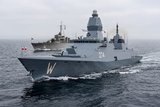
The Swedish Navy operates five Visby class corvettes. (Photo: Jimmie Adamsson/The Swedish Armed Forces)
Saab announced in 2021 that it had signed an agreement with Swedish defence procurement for the development of plans for a Visby upgrade. One aspect of the upgrade is for the introduction of a surface-to-air missile capability.


The Swedish Navy’s Visby-class corvettes are to be equipped with an anti-aircraft capability under a SEK1.6 billion (US$166 million) contract placed by the Swedish Defence Procurement Agency (FMV) with Saab.
The addition of the capability is part of a mid-life upgrade for the ships which are expected to remain in service until 2040.
The corvettes will thus be equipped with the ship-based air defence missile system Sea Ceptor and Common Anti-air Modular Missiles (CAMM) and in 2023 the FMV awarded a contract to MBDA for the supply of CAMM missiles.
The upgrade will be carried out at Saab in Karlskrona
Our news & analysis is now part of Defence Insight®
A Basic-level or higher Defence Insight subscription is now required to view this content.



More from Naval Warfare
-
![All eyes on Royal Navy’s Type 93 market engagement as industry prepares bids]()
All eyes on Royal Navy’s Type 93 market engagement as industry prepares bids
Responses are due by 29 October as the Royal Navy tests the market, with BAE Systems’ Herne and MSubs’ Excalibur setting up a contest where payloads may decide the winner.
-
![From Poland to the Pacific: can Miecznik become a blueprint for other navies?]()
From Poland to the Pacific: can Miecznik become a blueprint for other navies?
Babcock is taking its Polish industrial partnership approach to Denmark and New Zealand as navies seek sovereign shipbuilding skills alongside ships.
-
![Unsettled waters in the North: can navies still trust their Arctic acoustic maps?]()
Unsettled waters in the North: can navies still trust their Arctic acoustic maps?
The changing Arctic environment is creating new challenges for submarine detection, driving demand for distributed sensors, uncrewed underwater vehicles and real-time acoustic modelling.