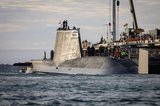
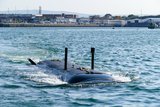
South Korea launches its first missile-capable submarine
South Korea launched its first ever missile-capable attack submarine on 14 September, despite a recent diplomatic thaw with the nuclear-armed North.
The $700 million, 3,000t Dosan Ahn Chang-ho submarine is capable of firing both cruise and ballistic missiles, and it is the first of three planned diesel-electric boats to go into service in the next five years.
It represented a ‘leap forward in the country’s’ defence industry, South Korean President Moon Jae-in told the audience at a launch ceremony at the Daewoo shipyard where it was designed and built.
Moon will head to Pyongyang in the week of 17 September for a third summit with the North’s leader Kim Jong-un, as US-led efforts to persuade Pyongyang to give up its nuclear weapons have stalled.
Moon said: ‘We have set off on a grand journey toward the denuclearisation of the Korean peninsula. But peace is not given gratuitously. Peace through power is the unwavering security strategy of this government.’
The new submarine is fitted with six vertical-launch tubes and features indigenous sonar and combat management systems.
Aside from the new vessels, South Korea has an existing fleet of 18 smaller submarines, all built in cooperation with Germany.
According to the defence ministry, the North has 70 ageing submarines and submersibles, and Yonhap news agency reported that it has also developed a new 2,500t submarine fitted with a vertical-launch system.





More from Naval Warfare
-
![Five years on: where could opportunities emerge next for AUKUS Pillar II?]()
Five years on: where could opportunities emerge next for AUKUS Pillar II?
Payload commonality, combat systems and electronic warfare are emerging as likely priorities as the trilateral partnership balances building submarines with sharing industrial ecosystems.
-
![Singapore expands maritime presence with future-ready Sentinel OPV]()
Singapore expands maritime presence with future-ready Sentinel OPV
Singapore is building space for uncrewed systems and future technologies into its new Sentinel-class OPVs, reflecting a wider move towards adaptable vessels capable of maintaining persistent maritime presence.
-
![From the Baltic to the Gulf: where USV procurement is heading next]()
From the Baltic to the Gulf: where USV procurement is heading next
Saildrone’s new Copenhagen base is one sign of a larger shift, as navies globally turn to uncrewed vessels for surveillance and mine clearance.
-
![Israeli Navy looks to expand as war reshapes future force requirements]()
Israeli Navy looks to expand as war reshapes future force requirements
Israel’s navy is preparing for a larger and more technically diverse role, but its ambitions could be impacted by supply chain restrictions, accelerating demand for domestic naval production as well as autonomous maritime capabilities.
-
![Quantum sensing gathers pace as navies eye undersea advantage]()
Quantum sensing gathers pace as navies eye undersea advantage
As AI dominates defence conversations, industry increasingly points to quantum sensing as the technology set to change submarine and uncrewed underwater vehicle operations.