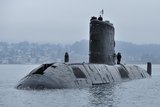
Sonardyne positioning systems for South Korea’s ASR-II


Sonardyne has announced that its underwater positioning and tracking technology will support search and recovery operations undertaken by the Republic of Korea Navy’s (RoKN’s) new auxiliary submarine rescue ship (ASR-II).
Under a contract with GE’s Power Conversion business, the ASR-II will be fitted with Sonardyne’s Ranger 2 Ultra-Short BaseLine system. This will interface onboard the vessel with GE’s Seastream Dynamic Position control system providing accurate and fast position reference updates during critical station keeping activities.
The Ranger 2 onboard the ASR-II will also be used to simultaneously track the position of, and communicate with, Sonardyne instrumentation fitted to the new, untethered Deep Search Rescue Vehicle (DSRV) that is being built to operate from the ship when it comes into service.
Ranger 2 uses Sonardyne’s 6G hardware and Wideband 2 signal technology to track underwater targets beyond 11km, with position updates acquired every second, allowing a vessel to work in any water depth, shallow or deep.
The ASR-II and its moonpool-deployed DSRV are being built under South Korea’s Defense Acquisition Program Administration as a replacement for the submarine rescue ship RoKS Cheonghaejin. The 5,200-tonne ASR-II is expected to be delivered to the RoKN by the end of 2022.

More from Naval Warfare
-
![US Navy $76.6bn award provides stability for submarine production]()
US Navy $76.6bn award provides stability for submarine production
The US Department of War’s US$76.6 billion Columbia-and Virginia-class submarine contract gives industry demand certainty as Washington seeks to rebuild its shipbuilding base.
-
![US Navy begins SPY-6(V)4 radar testing ahead of first Arleigh Burke destroyer backfit]()
US Navy begins SPY-6(V)4 radar testing ahead of first Arleigh Burke destroyer backfit
Wallops Island trials will validate the next-generation radar's combat system integration before its installation aboard USS Pinckney, the first Flight IIA destroyer to receive the SPY-6(V)4 upgrade.
-
![Hanwha Ocean deepens US ties and eyes Saudi submarine prospect after Canada setback]()
Hanwha Ocean deepens US ties and eyes Saudi submarine prospect after Canada setback
Hanwha Ocean is deepening ties with the US and eyeing a submarine opportunity in Saudi Arabia, as South Korea looks to convert its Canadian defeat into export momentum.
-
![A400M trial demonstrates airborne deployment of uncrewed surface vessel]()
A400M trial demonstrates airborne deployment of uncrewed surface vessel
Kraken Technology Group’s A400M airdrop of a K3 Scout uncrewed surface vessel points to a new way for navies to insert USVs into contested waters, bypassing ports and motherships.
-
![Babcock onshores 85% of Canada’s submarine supply chain as it eyes future CPSP programme]()
Babcock onshores 85% of Canada’s submarine supply chain as it eyes future CPSP programme
By moving most of the Royal Canadian Navy’s submarine supply chain into Canada, Babcock Canada is driving to strengthen sovereign sustainment capabilities while preparing to compete to maintain the future Canadian Patrol Submarine Project.