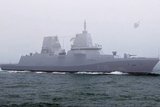
Raytheon to upgrade Japan’s Phalanx CIWS


Raytheon will supply Phalanx Close-in Weapon Systems (CIWS) upgrade kits, support equipment and hardware spares to the Japan Maritime Self-Defense Force (JMSDF) under a multi-year bulk buy contract announced on 30 October. The contract totals over $200 million.
CIWS is a central element of Japan’s Ship Self-Defense Program. The rapid-fire, computer-controlled radar and 20 mm gun system is designed to automatically acquire, track and destroy enemy threats that have penetrated all other ship defence systems.
Rick Nelson, vice president naval and area mission defense, Raytheon Missile Systems, said: ‘Phalanx provides the critical inner-layer of protection to sailors around the globe against threats that are continually evolving. Thanks to its array of sensors, Phalanx brings a proven solution against threats launched from land, sea or air.’
Phalanx Block 1B, the latest upgrade, with its surface mode configuration, augments the anti-air warfare capability by adding a forward looking infrared sensor and optimised gun barrels to the Block 1A configuration. It allows Phalanx to be used against littoral warfare threats such as helicopters and high-speed surface threats. Block 1B also adds new control stations with situational awareness that allows operators to visually track and identify targets before engagement.


More from Naval Warfare
-
![Germany sinks F126 frigate programme in favour of cheaper MEKO A-200]()
Germany sinks F126 frigate programme in favour of cheaper MEKO A-200
On 24 June 2026, the German Ministry of Defence announced it was cancelling the F126 frigate programme in favour of procuring eight MEKO A-200 DEU frigates.
-
![UK’s Type 31 frigate balances cost pressure with long-term export ambition]()
UK’s Type 31 frigate balances cost pressure with long-term export ambition
The UK shipbuilder’s full-year results to the end of March revealed the impact of the £140 million charge linked to design changes and rework on the Royal Navy’s Type 31 frigate programme.
-
![US Navy expands non-standard acquisitions to rapidly field emerging technologies]()
US Navy expands non-standard acquisitions to rapidly field emerging technologies
The US Navy is increasing the use of OTA obligations to accelerate the procurement of seabed-subsea, littoral, expeditionary and uncrewed solutions.