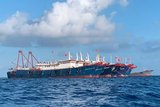
Piracy attacks on tankers increasing, says IMB


SOUTH East Asia had more piracy attacks than the rest of the world combined in 2014, according to figures released by the International Maritime Bureau (IMB).
Worldwide piracy figures are the lowest in eight years with the IMB’s Piracy Reporting Centre based in Kuala Lumpur, recording a total of 245 attacks and attempted attacks.
This total is down 44 per cent since the situation off Somalia created a global peak in 2011.
Somali pirates accounted for just 11 attacks last year, all of which were thwarted.
The focus of concern has now switched to South East Asia where more than
Our news & analysis is now part of Defence Insight®
A Basic-level or higher Defence Insight subscription is now required to view this content.

You may also like

More from Naval Warfare
-
![US Navy explores 3D-printed parts for Growler, Poseidon and Arleigh Burke destroyers]()
US Navy explores 3D-printed parts for Growler, Poseidon and Arleigh Burke destroyers
USN procurement notices point to potential uses for additive manufacturing in naval aviation and shipbuilding.
-
![Who commands the uncrewed systems when the mothership goes down?]()
Who commands the uncrewed systems when the mothership goes down?
In October 2026, the US Navy sent an uncrewed surface vessel to sea with a carrier strike group for the first time. It is a step forward for hybrid operations, but it raises an awkward question: what happens to the drones if the ship controlling them is lost?
-
![Greece’s $8.1 billion naval pipeline signals opportunities beyond frigates]()
Greece’s $8.1 billion naval pipeline signals opportunities beyond frigates
Defence Insight has identified 14 upcoming Greek naval programmes, with submarine replacement, uncrewed systems and longer-term fleet renewal offering potential opportunities for suppliers.
-
![Navantia pitches 64-cell F110 frigate and sets out plans for 75m autonomous vessel]()
Navantia pitches 64-cell F110 frigate and sets out plans for 75m autonomous vessel
With its second F110 frigate launched four months early, the Spanish shipbuilder is courting allied navies with a missile-defence upgrade and a 75m uncrewed vessel.
-
![Chinese maritime militia puts naval surveillance to the test]()
Chinese maritime militia puts naval surveillance to the test
With record deployments in the South China Sea and a newly reported sighting east of Taiwan, China’s maritime militia is putting greater pressure on regional surveillance. How can navies establish what these vessels are doing quickly and reliably enough to respond?