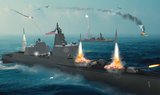
Northrop Grumman receives Arleigh Burke-class systems orders


Northrop Grumman will provide integrated bridge and navigation systems and steering gear systems as part of efforts to modernisation the US Navy’s Arleigh Burke-class guided missile destroyers (DDGs). The company was awarded contracts from the US Navy, General Dynamics Bath Iron Works and Huntington Ingalls Industries for the equipment.
The five integrated bridge and navigation systems (IBNS) will be supplied under exercised contract options by Naval Sea Systems Command (NAVSEA) valued at $11 million.
The steering gear systems will be acquired under options jointly exercised by General Dynamics Bath Iron Works and Huntington Ingalls Industries. The order for six systems is valued at $30 million.
The systems to be installed include radar systems, navigation software, ship control software, chart servers, network interface boxes, flat panel displays, global positioning systems, and ship control display systems. Northrop Grumman will also provide engineering services.
Back fit installation of the IBNS systems by the navy will be conducted at the home ports of the vessels during their modernisation windows. For the new build ships, steering gear systems and IBNS systems will be installed at the shipyards of Bath Iron Works and Huntington Ingalls Industries.
Bill Hannon, vice president of maritime systems, Northrop Grumman, said: ‘Northrop Grumman is a major partner on the navy’s DDG modernisation programme. The new IBNS and steering gear systems will keep the technology of our nation’s front-line surface combatants highly capable and affordable.’
Deliveries will begin in 2015 and are expected to be completed by 2021.



More from Naval Warfare
-
![US turns to allies to tackle navy shipbuilding backlog]()
US turns to allies to tackle navy shipbuilding backlog
A White House memorandum acknowledges US Navy shipbuilding backlogs and a weakened industrial base, opening a formal path for South Korean and Japanese yards to help rebuild capacity.
-
![US Navy’s $275 billion BBGN plan hinges on shipyard transformation]()
US Navy’s $275 billion BBGN plan hinges on shipyard transformation
The US Navy’s planned nuclear-powered warship carries a US$275 billion price tag, but the greater story lies in the industrial overhaul needed to build it, from AI-enabled design to digital twins and modular construction.
-
![Europe’s naval contractors benefit from growing refit and upgrade demand]()
Europe’s naval contractors benefit from growing refit and upgrade demand
Rheinmetall’s order to modernise the German Navy frigate Bayern points to a wider European shift towards extending warship service life as new-build programmes face delay.