US Navy selects five companies for FFG(X) design phase


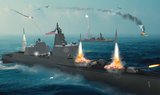
The US Navy has selected five companies to move forward with the conceptual design of its new Guided Missile Frigate FFG(X).
On 16 February, the service announced that it had selected Austal USA, Huntington Ingalls, Lockheed Martin, Marinette Marine (working with Fincantieri Marinette Marine) and General Dynamics Bath Iron Works to proceed with FFG(X) conceptual designs. For the 16 month phase, each company was award $15 million. Phase funding, however, may be increased.
This programme phase is expected to help the service ‘better understand the cost and capability drivers’ for designing and building FFG(X), the service said in a 16 February statement. Additionally, findings will be used to help craft vessel ’specifications’ for a competitive process and sole-source contract award in Fiscal Year 2020.
‘Throughout the accelerated acquisition process for FFG(X), the navy will incentivise industry to balance cost and capability and achieve the best value solution for the American taxpayer,’ the navy said in a statement.
‘This approach aligns to the National Defense Strategy’s stated goal of achieving a more lethal, resilient, and agile force by pursuing acquisition strategies to build ships more quickly and affordably, achieving the navy the nation needs.’
Joe DePietro, vice president of small combatants and ship systems at Lockheed Martin, said, ‘We are proud of our 15-year partnership with the US Navy on the Freedom-variant Littoral Combat Ship and look forward to extending it to FFG(X).
‘Built to US Navy shipbuilding standards, our frigate design offers an affordable, low-risk answer to meeting the navy’s goals of a larger and more capable fleet.’
Fincantieri CEO Giuseppe Bono also said his company is ‘honoured’ that its FREMM-design was selected to be evolved during this conceptual design phase.
‘We are committed to continue to play a part in the development of the US Navy’s small surface combatant strategy, central to our customer’s long-term goals for fleet size and to the growth of export for the American shipbuilding industry,’ Bono said in 19 February statement.



More from Naval Warfare
-
![US turns to allies to tackle navy shipbuilding backlog]()
US turns to allies to tackle navy shipbuilding backlog
A White House memorandum acknowledges US Navy shipbuilding backlogs and a weakened industrial base, opening a formal path for South Korean and Japanese yards to help rebuild capacity.
-
![US Navy’s $275 billion BBGN plan hinges on shipyard transformation]()
US Navy’s $275 billion BBGN plan hinges on shipyard transformation
The US Navy’s planned nuclear-powered warship carries a US$275 billion price tag, but the greater story lies in the industrial overhaul needed to build it, from AI-enabled design to digital twins and modular construction.
-
![Industry sees opportunity in Australia’s shift to networked undersea warfare]()
Industry sees opportunity in Australia’s shift to networked undersea warfare
Australia’s new defence innovation strategy indicates a shift from platform-centric to network-centric undersea warfare, with Ocius and Anduril Industries pointing to fast-growing opportunities for local industry.