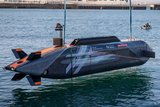
Intermarine completes pontoon for RN carriers


Intermarine UK has completed the construction of a floating platform for the Royal Navy’s Queen Elizabeth-class aircraft carriers.
It has built a 24x12 metre pontoon that will be moored to the stern of either HMS Queen Elizabeth or HMS Prince of Wales when anchored in Portsmouth, UK, allowing crew and passengers to board and disembark at the rear of the ship.
Intermarine UK, part of Polish-owned Inter Marine Group, opened a 2,000sqm fabrication and welding facility at Portland Port on England’s south coast at the start of 2018, and over the past year has spent in excess of £500,000 equipping the site with machinery.
The pontoon was built in four sections over a period of two-and-a-half months. Each part was then bolted together to create a floating platform with a lightship displacement of 86 tonnes. The bolted I-section framework in the middle of the pontoon carries a soft patch deck area of approximately 16x6 metres.
Prior to establishing its production facility the company was tasked with aligning and joining up sections of the two carriers.
Related Equipment in Defence Insight



More from Naval Warfare
-
![Canada assesses security equipment changes for Polar Icebreaker Imnaryuaq]()
Canada assesses security equipment changes for Polar Icebreaker Imnaryuaq
The Canadian Department of National Defence is evaluating communications and reconnaissance changes for CCGS Imnaryuaq’s expanded maritime security role, while retaining its 2032 acceptance target.
-
![All eyes on Royal Navy’s Type 93 market engagement as industry prepares bids]()
All eyes on Royal Navy’s Type 93 market engagement as industry prepares bids
Responses are due by 29 October as the Royal Navy tests the market, with BAE Systems’ Herne and MSubs’ Excalibur setting up a contest where payloads may decide the winner.
-
![US Navy’s MQ-25 Stingray approaches carrier-integration tests]()
US Navy’s MQ-25 Stingray approaches carrier-integration tests
Boeing has outlined its upcoming precision-landing and carrier-airspace trials as MQ-25 manufacturing shifts towards Illinois, with initial Lot 1 deliveries expected in 2029.
-
![From Poland to the Pacific: can Miecznik become a blueprint for other navies?]()
From Poland to the Pacific: can Miecznik become a blueprint for other navies?
Babcock is taking its Polish industrial partnership approach to Denmark and New Zealand as navies seek sovereign shipbuilding skills alongside ships.