HMS Queen Elizabeth completes work package


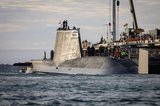
Babcock International has completed the first docking and maintenance period on the Royal Navy’s HMS Queen Elizabeth at its facility in Rosyth, UK, it was announced on 21 May.
After the planned six-week work package was successfully delivered, the carrier departed Rosyth through the specially designed rollerfender system into the River Forth.
Work under the contract included replacing 284 hull valves and renewing all cathodic protection electrodes and anodes, as well as painting the hull and carrying out work on the stabilisers, rudders and shaft lines.
HMS Queen Elizabeth is due to enter service in 2020 after extensive whole-ship trials.
Related Equipment in Defence Insight

You may also like

More from Naval Warfare
-
![Denmark’s air defence frigate requirement draws growing European competition]()
Denmark’s air defence frigate requirement draws growing European competition
With no formal competition under way, industrial partnerships, production capacity and air defence capability could all shape the programme as Denmark considers how to replace its three Iver Huitfeldt-class frigates.
-
![Five years on: where could opportunities emerge next for AUKUS Pillar II?]()
Five years on: where could opportunities emerge next for AUKUS Pillar II?
Payload commonality, combat systems and electronic warfare are emerging as likely priorities as the trilateral partnership balances building submarines with sharing industrial ecosystems.
-
![Singapore expands maritime presence with future-ready Sentinel OPV]()
Singapore expands maritime presence with future-ready Sentinel OPV
Singapore is building space for uncrewed systems and future technologies into its new Sentinel-class OPVs, reflecting a wider move towards adaptable vessels capable of maintaining persistent maritime presence.
-
![From the Baltic to the Gulf: where USV procurement is heading next]()
From the Baltic to the Gulf: where USV procurement is heading next
Saildrone’s new Copenhagen base is one sign of a larger shift, as navies globally turn to uncrewed vessels for surveillance and mine clearance.
-
![Israeli Navy looks to expand as war reshapes future force requirements]()
Israeli Navy looks to expand as war reshapes future force requirements
Israel’s navy is preparing for a larger and more technically diverse role, but its ambitions could be impacted by supply chain restrictions, accelerating demand for domestic naval production as well as autonomous maritime capabilities.
-
![Quantum sensing gathers pace as navies eye undersea advantage]()
Quantum sensing gathers pace as navies eye undersea advantage
As AI dominates defence conversations, industry increasingly points to quantum sensing as the technology set to change submarine and uncrewed underwater vehicle operations.