Indian Navy commissions three Immediate Support Vessels
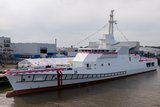
The Indian Navy commissioned the second batch of three Immediate Support Vessels (ISVs) in a ceremony at Naval Dockyard, Visakhapatnam on 24 March.
The first batch of ISVs was commissioned on 4 June 2014, and the second batch will be part of the 84th Immediate Support Vessel Squadron. Two of the ISVs were built by Rodman Spain while one was built by Abu Dhabi Ship Builders. The project was a collaboration between the shipbuilders, Oil and Natural Gas Corporation, and the Indian Navy.
Vice Admiral Satish Soni, commanding-in-chief eastern naval command, Indian navy, said: ‘These ISVs were brought to Naval Dockyard Mumbai where delivery acceptance trials were carried out. These ships have sailed 1,200 nautical miles from Mumbai to Visakhapatnam over duration of 12 days before getting commissioned at the eastern naval command.’
The ISVs feature heavy machine guns and are powered by two caterpillar engines rated at 1600 MHP each for water jet propulsion. They have a high speed of 40 knots and range of 500 nautical miles. They can carry out day and night surveillance and rapid insertions/extraction of MARCOS for military intervention.
These ships will augment efforts to improve coastal security and protect India’s offshore assets from asymmetric threats. These ships would enhance the navy’s capability in maritime safety and security over the offshore developmental areas on the eastern sea board.




More from Naval Warfare
-
![AUKUS heavyweight torpedo test raises questions over future armed UUV requirements]()
AUKUS heavyweight torpedo test raises questions over future armed UUV requirements
A heavyweight torpedo firing from the Royal Navy’s uncrewed submarine XV Excalibur suggests a shift beyond surveillance, with allied navies eyeing strike roles for large autonomous undersea vessels.
-
![Industrial teams prepare roadmap for Indonesia aircraft carrier transformation]()
Industrial teams prepare roadmap for Indonesia aircraft carrier transformation
Fincantieri and PT PAL have agreed on a framework to modernise the former Giuseppe Garibaldi, with drones, communications and broader Italian–Indonesian industrial ties involved.
-
![Five years on: where could opportunities emerge next for AUKUS Pillar II?]()
Five years on: where could opportunities emerge next for AUKUS Pillar II?
Payload commonality, combat systems and electronic warfare are emerging as likely priorities as the trilateral partnership balances building submarines with sharing industrial ecosystems.