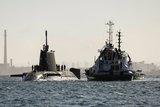
IMDEX 2013: Asia-Pacific navy procurement expected to increase


With countries in Asia-Pacific planning to spend some $200 billion by 2032 on new naval vessels, companies both from the region and globally are eagerly pursuing what has become the second largest market in the world.
Ng Eng Hen, Singapore's minister of defence, told the IMDEX exhibition on 14 May that secure sea routes remain critical to stability and economic growth in the region, while increasing threats, such as piracy, maritime terrorism, weapons of mass destruction proliferation and territorial disputes, pose new challenges.
‘These challenges cannot be solved by any one nation, no matter how well resourced,’ he argued. ‘Instead,
Already have an account? Log in
Want to keep reading this article?



More from Naval Warfare
-
![RTX Raytheon enhances SM-3 and SM-6 production capacity]()
RTX Raytheon enhances SM-3 and SM-6 production capacity
The expansion of the Redstone facility in Alabama will enable Raytheon to increase production of Standard Missiles in the location by 50% and support Washington in refilling stockpiles after recent operations have depleted the Pentagon’s reserves.
-
![Kraken’s Royal Navy USV contract signals next step in crewed-uncrewed integration]()
Kraken’s Royal Navy USV contract signals next step in crewed-uncrewed integration
The UK Royal Navy’s rapid procurement of uncrewed platforms aligns with the force’s strategic shift towards a fleet better equipped to handle modern threats.
-
![HMS Anson’s milestone stay in Australia cut short during AUKUS deployment]()
HMS Anson’s milestone stay in Australia cut short during AUKUS deployment
The Astute-class submarine’s visit to Australia was the first time maintenance activity on a UK Royal Navy nuclear submarine had been carried out in the country.
-
![How Operation Epic Fury could reduce US readiness to face China]()
How Operation Epic Fury could reduce US readiness to face China
The offensive against Iran could impact training and maintenance cycles and accelerate the degradation of the US arsenal on top of depleting Washington’s stockpiles.
-
![UK Royal Navy explores modular counter-drone capabilities for future hybrid fleet]()
UK Royal Navy explores modular counter-drone capabilities for future hybrid fleet
The UK MoD is scoping out systems to counter the growing threat of uncrewed aerial systems, with a focus on low-cost modularity and speed to field.