HMS Mersey joins patrol for Channel migrant dinghies


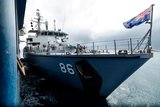
A UK Royal Navy ship was patrolling the Channel on 4 January in response to a wave of mostly Iranian asylum seekers risking the crossing from France in dinghies.
HMS Mersey is filling the gap until two Border Force cutters return from the European Union’s Mediterranean migrant crossings mission.
The OPV and 45 crew left the Channel port of Portsmouth on 3 January.
Attempts to get to Britain by crossing the world’s busiest shipping lane in tiny craft have surged in the last three months, with numbers spiking over the Christmas holidays.
‘HMS Mersey will deploy to the Dover Straits to assist the UK Border Force and French authorities with their response to migrant crossings,’ said UK Defence Secretary Gavin Williamson.
‘The crew have been able to immediately divert from routine operations to help prevent migrants from making the dangerous journey across the Channel.’
Two coastal patrol vessels and two UK Border Force cutters are already deployed in the Channel. Any migrants found in British waters are taken to a UK port.
The UK will keep one Border Force cutter on the EU Mediterranean mission and bring two back: Protector, which is anchored at the Greek island of Lesbos, and Seeker, which is docked in the overseas territory of Gibraltar.
Meanwhile, detectives are continuing to question two men arrested on suspicion of arranging the illegal movement of migrants into Britain.
A 33-year-old Iranian national and a 24-year-old British man, arrested in Manchester on 2 January, remain in police custody.
Some 539 people crossed the Dover Straits - the Channel’s narrowest part at 21 miles wide - in 2018, 80 percent making the journey in the last three months.


More from Naval Warfare
-
![Suppliers await next step in Australia’s mine warfare transition]()
Suppliers await next step in Australia’s mine warfare transition
Australia’s mine countermeasure capability remains in flux as the Huon-class nears retirement, but accelerated investment in autonomous systems is opening a path for industry.
-
![Can the US Navy ask Indo-Pacific allies to do more while training with them less?]()
Can the US Navy ask Indo-Pacific allies to do more while training with them less?
As the Iran War draws US ships and marine corps units away from the Indo-Pacific, curtailed exercises and a temporary carrier gap are exposing tensions between Washington’s demand for more self-reliant allies and the joint training needed to realise that ambition.
-
![How could Rheinmetall’s GMF 140 fit with ongoing programmes in North America?]()
How could Rheinmetall’s GMF 140 fit with ongoing programmes in North America?
With Canada committed to its River-class replacement and the USN pursuing a lower-cost frigate, Rheinmetall will need to demonstrate where the GMF 140 can fill a capability gap in the North American fleet.
-
![Australian industry programme builds pipeline for Virginia-class sustainment]()
Australian industry programme builds pipeline for Virginia-class sustainment
Australian businesses can now bid to support Virginia-class submarine sustainment in Western Australia, as momentum around the Henderson Defence Precinct also builds.
-
![South Korea, Japan and Turkey vie for US shipbuilding access in future frigate contest]()
South Korea, Japan and Turkey vie for US shipbuilding access in future frigate contest
Washington’s search for a foreign-built frigate could hand South Korea, Japan and Turkey a larger prize than a double-hull order: a foothold inside the US shipbuilding industrial base.
-
![Japan’s FY2027 budget bets on stand-off systems to offset demographic decline]()
Japan’s FY2027 budget bets on stand-off systems to offset demographic decline
Japan’s FY2027 defence budget backs stand-off strike, a 17-aircraft MQ-9B buy and a declared bid to lead the world in uncrewed maritime assets, alongside new frigates, submarines and support ships.