Hanwha demonstrates anti-submarine UUV for ROKN
This graphic shows the operating concept of how an ASWUUV would operate with USVs and surface warships to counter hostile submarines. (Image: Hanwha Systems)
Hanwha Systems is working on USVs and UUVs for South Korea’s navy, including an anti-submarine type. The country is also working to improve its AIP and fuel cell technology.


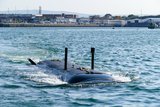
On 30 June, South Korea’s Agency for Defense Development (ADD) announced that a developmental anti-submarine warfare unmanned underwater vessel (ASWUUV) had successfully performed an operational demonstration.
The test occurred off the coast of Tongyeong, on South Korea’s southern coast. After being launched, the ASWUUV from Hanwha Systems demonstrated its ability to move autonomously and to conduct anti-submarine searching and tracking.
An ADD spokesperson remarked, ‘The test is very noteworthy because we were able to demonstrate the effectiveness of the platform’s most important technologies.’
Further ADD tests are slated for September to evaluate the UUV’s autonomous operating system, sonars and fuel
Our news & analysis is now part of Defence Insight®
A Basic-level or higher Defence Insight subscription is now required to view this content.


More from Naval Warfare
-
![Singapore expands maritime presence with future-ready Sentinel OPV]()
Singapore expands maritime presence with future-ready Sentinel OPV
Singapore is building space for uncrewed systems and future technologies into its new Sentinel-class OPVs, reflecting a wider move towards adaptable vessels capable of maintaining persistent maritime presence.
-
![Israeli Navy looks to expand as war reshapes future force requirements]()
Israeli Navy looks to expand as war reshapes future force requirements
Israel’s navy is preparing for a larger and more technically diverse role, but its ambitions could be impacted by supply chain restrictions, accelerating demand for domestic naval production as well as autonomous maritime capabilities.
-
![Quantum sensing gathers pace as navies eye undersea advantage]()
Quantum sensing gathers pace as navies eye undersea advantage
As AI dominates defence conversations, industry increasingly points to quantum sensing as the technology set to change submarine and uncrewed underwater vehicle operations.