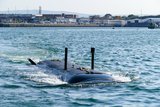
France tests subsea robotics for future seabed mapping missions
Sonar image from A18D AUV. (Photo: ECA Group)
French Navy and DGA put an autonomous underwater vehicle through its paces.


The French Navy and Naval Hydrographic and Oceanographic Service (SHOM), working with the national procurement agency DGA, have evaluated the A18D autonomous underwater vehicle (AUV) from ECA Group.
This evaluation was conducted with the Future Hydrographic and Oceanographic Capacity (CHOF) programme in mind, ECA stated on 11 October.
The AUV was launched from the French Navy offshore support vessel Rhône on ‘a large variety of missions to precisely map the relief and sea beds down to 3000m depth, in the currents and swell of the Atlantic’, the company added.
The A18D can function autonomously for 24h to carry out inspection and 3D seabed mapping missions.
‘The example of the A18D tested showed a high level of reliability and proved to be easy to install and operate, thanks to its optimised size-to-weight ratio (5.7m-780kg) and its intuitive user interface.’
In addition, the French Navy and SHOM teams were able to evaluate the potential of using a UAV to ‘accompany and enrich’ subsea robotic missions, ECA noted.
CHOF is intended to update and develop French oceanographic and hydrographic data acquisition and processing capabilities, by replacing three crewed vessels with autonomous platforms.



More from Naval Warfare
-
![Five years on: where could opportunities emerge next for AUKUS Pillar II?]()
Five years on: where could opportunities emerge next for AUKUS Pillar II?
Payload commonality, combat systems and electronic warfare are emerging as likely priorities as the trilateral partnership balances building submarines with sharing industrial ecosystems.
-
![Singapore expands maritime presence with future-ready Sentinel OPV]()
Singapore expands maritime presence with future-ready Sentinel OPV
Singapore is building space for uncrewed systems and future technologies into its new Sentinel-class OPVs, reflecting a wider move towards adaptable vessels capable of maintaining persistent maritime presence.
-
![From the Baltic to the Gulf: where USV procurement is heading next]()
From the Baltic to the Gulf: where USV procurement is heading next
Saildrone’s new Copenhagen base is one sign of a larger shift, as navies globally turn to uncrewed vessels for surveillance and mine clearance.
-
![Israeli Navy looks to expand as war reshapes future force requirements]()
Israeli Navy looks to expand as war reshapes future force requirements
Israel’s navy is preparing for a larger and more technically diverse role, but its ambitions could be impacted by supply chain restrictions, accelerating demand for domestic naval production as well as autonomous maritime capabilities.
-
![Quantum sensing gathers pace as navies eye undersea advantage]()
Quantum sensing gathers pace as navies eye undersea advantage
As AI dominates defence conversations, industry increasingly points to quantum sensing as the technology set to change submarine and uncrewed underwater vehicle operations.