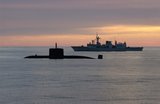
Fleet Certification Period 2020 underway


The Royal Australian Navy’s (RAN’s) first major exercise for 2020, Fleet Certification Period 2020 (FCP20), got underway from Sydney on 17 February.
The exercise’s sea phase will take place until 6 March, with RAN vessels HMAS Hobart, Stuart, Arunta and Sirius carrying out war games in the vicinity of Bass Strait with five other Australian ships, submarines, RAN MH-60R helicopters and Royal Australian Air Force P-8A aircraft.
The exercise will also include military aircraft from the US (P-8) and New Zealand (P-3K).
FCP20 will further develop the RAN’s ability to engage in complex and dynamic warfighting activities based around sea and air control capabilities. At the same time, Australian Clearance Diving Team One will also conduct water mine counter measure operations as part of a Mine Counter Measures Task Group deployed to North Eastern Tasmania.
The exercise will also include port visits to Melbourne and Portland in Victoria and Burnie, Devonport and Launceston in Tasmania.
FCP20 also marks the first time a Hobart-class destroyer, HMAS Hobart, has participated in a fleet certification period.
Related Equipment in Defence Insight



More from Naval Warfare
-
![Canada’s submarine availability under pressure as Chicoutimi is unlikely to return to front-line duties]()
Canada’s submarine availability under pressure as Chicoutimi is unlikely to return to front-line duties
HMCS Victoria and HMCS Windsor could return from their current deep maintenance, but unconfirmed operational timelines leave questions over patrol capacity before the first CPSP arrives.
-
![Patrol vessel demand and partnerships anchor North Africa’s naval market]()
Patrol vessel demand and partnerships anchor North Africa’s naval market
Fincantieri and Naval Group are positioning for long-term work in Egypt and Morocco as demand for local industrial partnerships grows.
-
![UK MoD faces ‘serious’ ASW gap as Defence Committee outlines Arctic requirements]()
UK MoD faces ‘serious’ ASW gap as Defence Committee outlines Arctic requirements
Anti-submarine warfare, uncrewed vessels and seabed monitoring top the demand list in the Defence Committee’s High North roadmap for the 2030s.
-
![Autonomy gives Turkey a chance to outflank established naval shipbuilders]()
Autonomy gives Turkey a chance to outflank established naval shipbuilders
Turkish shipbuilders have sold ships from Asia to Europe, but autonomy and swarm technology could give them a fairer fight against Western European rivals.