Damen to build tug for Royal Navy


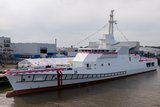
Damen Shipyards has been contracted by Serco to deliver a tug to support the Royal Navy’s two new aircraft carriers at the Portsmouth naval base, Damen announced on 12 February.
The deal forms a part of Serco’s contract to provide marine services to the UK Ministry of Defence.
Damen’s Advanced Rotortug (ART) 80-32 tug will meet the towing flexibility, power (80 tonnes Bollard Pull) and manoeuvrability needed to support the Queen Elizabeth Class aircraft carriers.
The 32.9m ART features the Rotortug propulsion system consisting of three azimuthing thrusters which provide omni-directional manoeuvrability, and a fully redundant and precise machinery configuration.
Serco has specified a number of modifications to the design, including a double drum render /recovery aft winch for redundancy and a foldable mast for safe working under the flight deck overhang. The vessel will also be fitted with controllable pitch propellers in the place of the usual fixed pitch propellers found on other ART 80-32 vessels.
Damen has started building the tug and is expected to deliver it to Serco in early 2017.
Iain MacLeod, business operations manager, Serco Marine Services, said: ‘There were significant challenges to be met with respect to vessel power, manoeuvrability, customisation and delivery time, but once again, it was a pleasure to deal with Damen who more than rose to the challenge.’


More from Naval Warfare
-
![AUKUS heavyweight torpedo test raises questions over future armed UUV requirements]()
AUKUS heavyweight torpedo test raises questions over future armed UUV requirements
A heavyweight torpedo firing from the Royal Navy’s uncrewed submarine XV Excalibur suggests a shift beyond surveillance, with allied navies eyeing strike roles for large autonomous undersea vessels.
-
![Industrial teams prepare roadmap for Indonesia aircraft carrier transformation]()
Industrial teams prepare roadmap for Indonesia aircraft carrier transformation
Fincantieri and PT PAL have agreed on a framework to modernise the former Giuseppe Garibaldi, with drones, communications and broader Italian–Indonesian industrial ties involved.
-
![Five years on: where could opportunities emerge next for AUKUS Pillar II?]()
Five years on: where could opportunities emerge next for AUKUS Pillar II?
Payload commonality, combat systems and electronic warfare are emerging as likely priorities as the trilateral partnership balances building submarines with sharing industrial ecosystems.