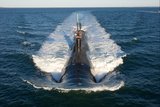
BAE Systems wins US DDG Destroyers contract
BAE Systems has been awarded a contract by the Naval Air Warfare Center – Aircraft Division to design, install and test onboard radio communications and network capability for the US Navy’s new DDG 113 and DDG 114 destroyers. The contract will see BAE Systems provide a range of services including systems engineering, production integration, logistics, crew training and configuration management.
According to the company, the installed technology will include multi-spectrum radio sets, antenna systems and baseband switching, as well as data-link modems and message distribution services.
The contract includes a one-year base, plus four option years. In total it has a potential value of $37 million.






More from Naval Warfare
-
![The UK joins the movement towards joint procurement]()
The UK joins the movement towards joint procurement
The UK will spend an estimated US$3.89 billion over the next decade in joint naval programmes, a lot of which will be in cooperation with Norway.
-
![Rheinmetall’s GMF 140: Ambitious frigate or market misfit?]()
Rheinmetall’s GMF 140: Ambitious frigate or market misfit?
Rheinmetall has unveiled its first next-generation frigate design, showing ambitions to compete as a surface combatant prime contractor. While the company is targeting North America, analysts believe the concept may be better positioned for future European programmes.
-
![US Navy $76.6bn award provides stability for submarine production]()
US Navy $76.6bn award provides stability for submarine production
The US Department of War’s US$76.6 billion Columbia-and Virginia-class submarine contract gives industry demand certainty as Washington seeks to rebuild its shipbuilding base.
-
![Hanwha Ocean deepens US ties and eyes Saudi submarine prospect after Canada setback]()
Hanwha Ocean deepens US ties and eyes Saudi submarine prospect after Canada setback
Hanwha Ocean is deepening ties with the US and eyeing a submarine opportunity in Saudi Arabia, as South Korea looks to convert its Canadian defeat into export momentum.