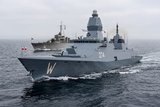
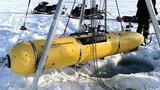
AN/AQS-20A sonar set for improvements


Raytheon and the US Naval Undersea Warfare Center (NUWC) are working to improve the capabilities of the US Navy’s AN/AQS-20A minehunting sonar, the company announced on 27 August.
Under a ‘work for private party’ contract funded by Raytheon, the team is analysing the AN/AQS-20A’s synthetic aperture sonar to improve its ability to capture and process high- and low-resolution images of underwater mines.
The enhancements will enable the sonar to produce better quality images of objects found deep under water to aid in the identification and classification of mines. A series of lab- and sea-based tests will be carried out to evaluate and exercise the sonar’s features to optimise the quality of both high- and low-resolution imaging.
The AN/AQS-20A is the variable depth sonar for the AN/WLD-1 Remote Minehunting System (RMS) deployed from the navy’s Littoral Combat Ship (LCS). The system is towed undersea to simultaneously scan the water column for anti-shipping mines forward of, to the sides, and beneath the vehicle. Sophisticated sonar, electro-optical sensors, and high-precision location information are used to provide high-resolution images of mines and mine-like objects.
Kevin Peppe, vice president of Raytheon Integrated Defense Systems’ Seapower Capability Systems, said: ‘Extending our long history of collaboration with our NUWC neighbours, this project brings together our respective sonar experts to maximise the performance of a critical undersea warfare capability. Our goal is to build on the system’s proven performance and further the advantage that AN/AQS-20A provides to the navy to safely detect and effectively identify these undersea threats.’


More from Naval Warfare
-
![Canada assesses security equipment changes for Polar Icebreaker Imnaryuaq]()
Canada assesses security equipment changes for Polar Icebreaker Imnaryuaq
The Canadian Department of National Defence is evaluating communications and reconnaissance changes for CCGS Imnaryuaq’s expanded maritime security role, while retaining its 2032 acceptance target.
-
![US Navy’s MQ-25 Stingray approaches carrier-integration tests]()
US Navy’s MQ-25 Stingray approaches carrier-integration tests
Boeing has outlined its upcoming precision-landing and carrier-airspace trials as MQ-25 manufacturing shifts towards Illinois, with initial Lot 1 deliveries expected in 2029.
-
![From Poland to the Pacific: can Miecznik become a blueprint for other navies?]()
From Poland to the Pacific: can Miecznik become a blueprint for other navies?
Babcock is taking its Polish industrial partnership approach to Denmark and New Zealand as navies seek sovereign shipbuilding skills alongside ships.
-
![Unsettled waters in the North: can navies still trust their Arctic acoustic maps?]()
Unsettled waters in the North: can navies still trust their Arctic acoustic maps?
The changing Arctic environment is creating new challenges for submarine detection, driving demand for distributed sensors, uncrewed underwater vehicles and real-time acoustic modelling.