Raytheon minehunting sonar to equip US Navy LCS


Raytheon will provide the US Navy with AN/AQS-20A minehunting sonar systems and equipment for deployment on the force’s Littoral Combat Ship (LCS) as part of a $35.5 million contract announced on 3 March.
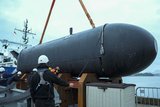
As the variable depth sonar for the AN/WLD-1 Remote Minehunting System (RMS), the AN/AQS-20A system is towed undersea to scan the water in front, below and to the sides of the vehicle for anti-shipping mines. Sophisticated sonar, electro-optical sensors, and high-precision location information are used to provide high-resolution images of mines and mine-like objects.
Kevin Peppe, vice president of Seapower Capability Systems, Raytheon’s Integrated Defense Systems business, said: ‘An essential component of LCS, AN/AQS-20A advances the capability of the ship’s mine countermeasure arsenal. Enhanced to optimise detection - in both range and accuracy, AN/AQS-20A provides the navy with the advantage they need to safely detect and effectively identify these undersea threats.’
The system can be used to support mine-clearing operations in both deep-ocean and littoral waters; and according to the company, the AN/AQS-20A is the only minehunting sonar sensor developed, tested and certified for Remote Multi Mission Vehicle (RMMV) deployment.




More from Naval Warfare
-
![AUKUS heavyweight torpedo test raises questions over future armed UUV requirements]()
AUKUS heavyweight torpedo test raises questions over future armed UUV requirements
A heavyweight torpedo firing from the Royal Navy’s uncrewed submarine XV Excalibur suggests a shift beyond surveillance, with allied navies eyeing strike roles for large autonomous undersea vessels.
-
![Industrial teams prepare roadmap for Indonesia aircraft carrier transformation]()
Industrial teams prepare roadmap for Indonesia aircraft carrier transformation
Fincantieri and PT PAL have agreed on a framework to modernise the former Giuseppe Garibaldi, with drones, communications and broader Italian–Indonesian industrial ties involved.
-
![Five years on: where could opportunities emerge next for AUKUS Pillar II?]()
Five years on: where could opportunities emerge next for AUKUS Pillar II?
Payload commonality, combat systems and electronic warfare are emerging as likely priorities as the trilateral partnership balances building submarines with sharing industrial ecosystems.