Iron Fist Light proceeds to Phase II


The US Army Requirements Oversight Council has decided to proceed with IMI Systems’ Iron Fist Light (IFL) active protection system (APS) for its Bradley Fighting Vehicles.
General Dynamics Ordnance and Tactical Systems (GD-OTS), working in cooperation with Elbit Systems and IMI, will now enter into Phase II of the IFL APS programme. The IFL is low in size and weight and easy to integrate.
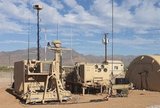
The protection system uses independent optical sensors, tracking radar, launchers and countermeasure munitions to defeat a wide range of threats at a safe distance from the vehicle. The system provides 360° protection coverage for close-range scenarios in both in open terrain and urban environments.
Steve Elgin, VP and general manager of armament and platform systems for GD-OTS, said: ‘We are excited to move into Phase II and bring the vast capabilities of our active protection system to the Bradley Fighting Vehicle. We look forward to continuing to partner with the army on advancing this important technology as well as enhancing integration capabilities across multiple army platforms.’
Fielding active protection capabilities has been identified as an urgent need by the US Army.
Related Equipment in Defence Insight


More from Land Warfare
-
![Europe commits to long-range fires but countries move in different directions]()
Europe commits to long-range fires but countries move in different directions
Sweden, Croatia and France are pursuing different rocket artillery solutions as European armies seek greater reach, survivability and industrial resilience.
-
![Polaris expands Arctic mobility offering as US military orders grow]()
Polaris expands Arctic mobility offering as US military orders grow
The Military 850 Voyageur 155 Crossover has secured orders from the US Army, Air Force and Marine Corps, addressing demand for agile Arctic mobility with passenger, cargo and towing capacity.
-
![Northrop Grumman pushing ahead with smaller Integrated Battle Command System]()
Northrop Grumman pushing ahead with smaller Integrated Battle Command System
Northrop Grumman’s Integrated Battle Command System is in service with Polish forces and is being introduced to US forces, with further development underway on the original platform as well as a smaller, more mobile system.
-
![UK’s ground-based air defence effort remains in assessment phase after third industry day]()
UK’s ground-based air defence effort remains in assessment phase after third industry day
The UK’s plan to introduce a new air defence capability into the British Army will cover short and medium-range defence as well as counter-uncrewed aerial system systems. Timelines are not yet laid out but industry is making plans.